Free AI Skills Assessment: Test Your AI Skills
Free AI skills assessment through conversation, not quizzes. Scored across 5 dimensions and 11 criteria. Get your AI skills certificate.
What is an AI skills assessment?
An AI skills assessment is a structured evaluation of how effectively a person uses artificial intelligence tools in their work. Unlike traditional knowledge tests that ask you to recall facts about machine learning or list AI tools, a proper AI skills assessment measures practical proficiency — how you actually prompt, iterate, evaluate outputs, integrate AI into workflows, and think critically about AI limitations.
The difference matters. Someone who can define "retrieval-augmented generation" on a quiz might score zero on a practical AI skills test if they've never actually used AI to solve a real work problem. An AI skills assessment closes that gap between knowing about AI and knowing how to use it.
Most AI assessments on the market fall into one of three categories:
- Multiple-choice quizzes — Fast, cheap, easy to game. They test vocabulary, not skill. You can pass most of them by reading a blog post the night before.
- Self-assessment surveys — "Rate your AI proficiency from 1 to 5." People consistently overestimate their own abilities. These produce feel-good data, not actionable insights.
- Conversational assessments — An AI interviewer has a real conversation with you, evaluates your responses in real time, and produces an evidence-based report. This is what AISA's free AI skills assessment does — and it's the only format that reliably distinguishes between people who talk about AI and people who use it well.
The World Economic Forum's Future of Jobs Report identifies AI literacy as one of the fastest-growing skill requirements globally, with employers across industries reporting that AI proficiency is shifting from "nice to have" to baseline expectation.
Why take a free AI skills assessment in 2026
AI proficiency is no longer optional. It's becoming a baseline expectation across industries — from marketing to software engineering to finance to design. The shift happened fast: in 2024, AI fluency was a differentiator. In 2026, it's table stakes.
The challenge is that AI skills are invisible. You can't tell from a CV whether someone prompts effectively or just pastes questions into ChatGPT and accepts whatever comes back. Hiring managers can't assess it in a 30-minute behavioural interview. And most people genuinely don't know where they stand — they either overestimate ("I use AI every day, I must be good") or underestimate ("I only use it for simple things").
A free AI skills assessment solves three problems at once:
For individuals: You get an honest, evidence-based picture of your AI proficiency. Not a self-assessment. Not a quiz score. A detailed breakdown of your actual strengths and gaps across five dimensions of AI fluency. That clarity is the starting point for deliberate improvement — you can't fix what you can't measure.
For career development: AI skills are one of the fastest-growing credential categories on LinkedIn. According to LinkedIn's 2025 Workplace Learning Report, AI-related skills appeared in job postings at 2x the rate of the previous year. A verified AI skills certificate backed by real assessment data — not a course completion badge — signals to employers that you've been independently evaluated.
For teams and hiring managers: A standardised AI skills test creates a common language for measuring AI readiness across candidates and employees. It replaces gut-feel assessments ("she seems pretty good with AI") with quantified, comparable data across five dimensions.
How AISA's free AI skills test works
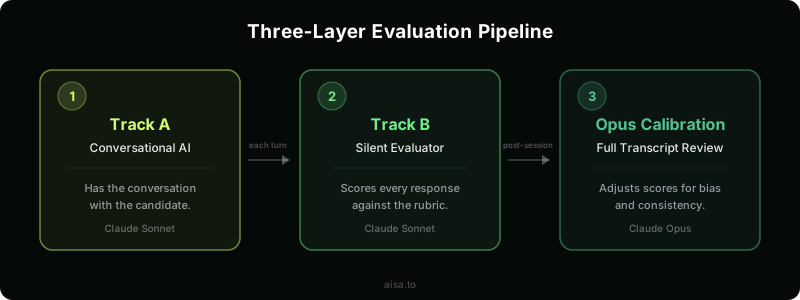
AISA is a conversational AI skills assessment. Instead of asking you to pick answers from a list, you have a 20-minute conversation with Aisa — an AI interviewer that adapts to your role, experience level, and the natural flow of the conversation.
Here's what happens under the hood:
Two AI models run in parallel on every turn. One AI (Track A) has the conversation with you — asking questions, running exercises, following up on interesting threads. A second AI (Track B) silently evaluates every response you give against 11 scoring criteria in real time. You never see Track B. It never interrupts. But it's the reason the AI skills assessment produces evidence-based scores rather than impressions.
The conversation adapts to you. Aisa doesn't follow a script. If you're a developer, she'll ask about APIs, code generation, and debugging workflows. If you're a product manager, she'll explore how you use AI for prioritisation, stakeholder communication, and strategic planning. If you're a designer, she'll focus on iteration, creative AI tools, and feedback loops. The assessed criteria are identical — the entry points are different.
Exercises test real skill, not recall. Mid-conversation, Aisa introduces short interactive exercises — a broken AI output to diagnose, a prompt to iterate on, a workflow to decompose, a tool selection challenge. These produce the highest-quality evidence for scoring because they test what you do, not what you describe. In assessment terminology, this is the difference between "demonstrated" and "described" evidence — and AISA weights demonstrated evidence significantly higher.
A third AI reviews the whole transcript. After the conversation, a more capable AI model reads the full session holistically and adjusts any scores that don't hold up under whole-session review. This three-layer architecture prevents both the halo effect (one good answer inflating everything) and the anchoring effect (one early impression distorting later scoring). For a deep dive into why conversational assessment outperforms quizzes, see Beyond Multiple Choice.
What the AI skills assessment measures
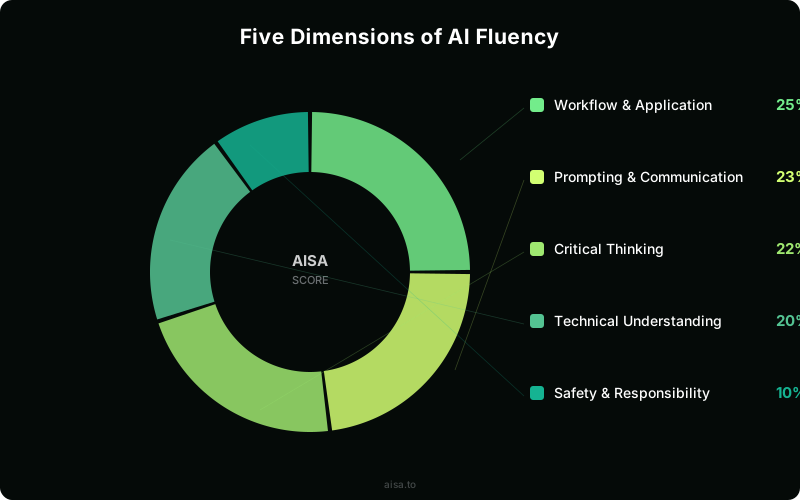
The free AI skills assessment evaluates you across five dimensions and 11 specific criteria:
Prompting & Communication (23%)
- Prompt Design — How you structure instructions for AI. Single-sentence commands score low. Structured prompts with role, context, constraints, and output format score high.
- Iterative Dialogue — How you follow up when the first output isn't right. Accepting it scores low. Diagnosing specific issues and targeting them in follow-ups scores high.
- Context & Memory Management — How you handle context windows, memory tools, system prompts, and multi-conversation workflows.
Critical Thinking (22%)
- Output Evaluation — Do you verify AI output systematically, or trust it at face value? Do you have a methodology for catching errors?
- Limitation Awareness — Do you understand where AI fails and adjust your approach before it goes wrong? Can you predict failure modes from experience?
Technical Understanding (20%)
- AI Fundamentals — Your mental model of how AI works — tokens, training data, inference, architecture. Not vocabulary, but applied understanding.
- Tool Landscape — Which tools you use, why you chose them, how you differentiate between options.
Workflow & Application (25%)
- Workflow Integration — How deeply AI is embedded in your daily work. Could you remove AI and keep working normally, or would your workflow collapse?
- Task Decomposition — How you break complex tasks into AI-suitable and human-suitable components.
- Domain Application — How you tailor AI use to your specific industry and role context.
Safety & Responsibility (10%)
- AI Safety — Your awareness of risks, data boundaries, bias, hallucination, over-reliance, and downstream impact on others.
Each criterion is scored 1-10 based on direct evidence from the conversation. No self-reporting. No guesswork. Every score is backed by specific quotes and reasoning from what you actually said and demonstrated. For the full scoring framework, see The AISA Rubric.
What you get from the free AI skills test
After your conversation with Aisa, the AI skills assessment produces a detailed results package:
A full AI skills report. Your scores across all five dimensions, with each criterion showing where you sit on the proficiency scale — Emerging, Developing, Proficient, or Expert. The report identifies your strongest dimension and your biggest growth opportunity, backed by evidence from your own words. See a sample report.
Your AI persona. AISA classifies you as one of 10 AI personas — from the Bystander (AI is on your radar but not in your routine) to the Architect (sophisticated multi-system integrations) to the Oracle (principles-level understanding of how AI works). Your persona captures your relationship with AI in a way a single number can't.
An official AI skills certificate. A LinkedIn-verifiable AI skills certification that you can add to your profile in one click. Unlike course completion certificates, this one is backed by an evidence-based assessment of what you actually demonstrated — not what you sat through.
A personalised learning plan. Based on your specific gaps, concrete recommendations — which tools to try, which skills to develop, what to practice this week. Not generic advice, but actions calibrated to your score level and role. You can continue improving with the AI Coach.
Global leaderboard ranking. See how your AI proficiency compares against other professionals who have taken the AI skills test. Your score joins the leaderboard when your report is ready, and you can remove it at any time.
Curious about your AI Fluency?
AISA helps you measure, prove and improve your AI skills — free report in a 20-minute chat.
AI skills test vs AI certification vs AI quiz — what's the difference?
These terms get used interchangeably, but they measure fundamentally different things:
| AI Skills Quiz | AI Skills Test | AI Skills Assessment | AI Certification | |
|---|---|---|---|---|
| Format | Multiple choice | Timed problems | Conversation + exercises | Assessment + credential |
| What it measures | Knowledge recall | Task completion | Applied proficiency | Proficiency + verified credential |
| Can it be gamed? | Easily | Somewhat | Very difficult | Very difficult |
| Evidence quality | Low | Medium | High | High |
| Time investment | 5-10 min | 15-30 min | 20-40 min | 20-40 min |
| Output | Pass/fail or percentage | Score | Detailed report + persona | Report + shareable certificate |
AISA combines the depth of an AI skills assessment with the credibility of an AI certification. You don't just get a number — you get an evidence-based report, a persona classification, and a certificate backed by scored criteria and conversation evidence.
The key distinction: quizzes test what you know about AI. A real AI skills test tests what you can actually do with it. That's why conversational assessment produces higher-quality data than any multiple-choice format — and why employers increasingly prefer evidence-based AI skills assessments over self-reported surveys.
AI skills certification by role
The assessment adapts to your profession. We've written detailed guides for how AI certification applies to specific roles:
- AI Skills Certification for Project Managers — Sprint planning, risk analysis, stakeholder communication
- AI Skills Certification for HR Professionals — AI sourcing, bias auditing, compliance
- AI Skills Certification for Lawyers — Contract analysis, legal research verification, privilege
- AI Skills Certification for Finance Professionals — Model risk, regulatory compliance, forecasting
- AI Skills Certification for Product Managers — Roadmap prioritisation, feature scoping, user research
- AI Skills Certification for Software Developers — Code generation, debugging, architecture decisions
- AI Skills Certification for Teachers — Lesson planning, differentiation, academic integrity
- AI Skills Certification for Accountants — Reconciliation, audit, tax research
- AI Skills Certification for Data Scientists — RAG pipelines, evaluation, model selection
- AI Skills Certification for UX Designers — Generative workflows, prototyping, user testing
- AI Skills Certification for Marketers — Content strategy, campaign analysis, brand voice
- AI Skills Certification for Sales Professionals — Prospecting, pipeline analysis, proposal drafting
- AI Skills Certification for Engineers — Simulation, CAD, predictive maintenance
- AI Skills Certification for Consultants — Client delivery, frameworks, knowledge synthesis
- AI Skills Certification for Executives — Strategy, governance, organisational AI adoption
- AI Skills Certification for Healthcare Professionals — Clinical decision support, documentation, compliance
- AI Skills Certification for Recruiters — Sourcing, screening, candidate assessment
- AI Skills Certification for Business Analysts — Requirements, data modelling, process automation
- AI Skills Certification for Customer Success Managers — Churn prediction, health scoring, renewal strategy
- AI Skills Certification for Operations Managers — Process mining, supply chain, workforce scheduling
Who should take the free AI skills assessment?
Professionals who use AI at work — whether you're a power user or just getting started. The assessment adapts to your level. Scoring a 40 with a clear growth plan is more valuable than not knowing where you stand.
Job seekers and career changers — AI proficiency appears in a growing number of job requirements. A verified AI skills certificate on your LinkedIn profile is a concrete signal that you've been independently evaluated — stronger than listing "proficient in AI tools" with no evidence.
Managers and team leads — Understanding your own AI proficiency helps you lead by example and have informed conversations about AI adoption on your team. For team-wide assessment, see AI Readiness for Teams.
Students and early-career professionals — Building AI fluency early compounds. The assessment gives you a baseline, a learning plan, and a credential before you need it for a job application.
Anyone curious about where they stand — "How good am I at using AI?" is a question most people can't answer objectively. A free AI skills assessment gives you a data-backed answer in 20 minutes.
How your AI skills assessment score is calculated
AISA's scoring pipeline is designed to prevent the two most common problems with AI assessments: score inflation and vocabulary-without-proficiency.
Evidence-based scoring. Every score requires a direct quote from the conversation. Saying "I use RAG" doesn't earn a high Technical Understanding score. Explaining how you built a retrieval pipeline, what embedding model you chose, and why — that does.
Demonstrated beats described. There's a strict evidence hierarchy: showing a skill in a live exercise scores higher than describing it in conversation, which scores higher than mentioning it in passing. Saying "my team builds AI agents" caps your personal proficiency score at 4 unless you explain your own hands-on role in building them.
Dual-AI cross-verification. The two AI models — one conversing, one evaluating — operate independently. The conversational AI doesn't know your scores. The evaluating AI doesn't influence the conversation. After the session, a third AI model reviews the full transcript holistically and adjusts any scores that don't hold up under whole-session review. This three-layer architecture prevents both the halo effect (one good answer inflating everything) and the anchoring effect (one early impression distorting later scoring).
Normalised scoring. Raw 1-10 criterion scores are normalised to a 0-100 composite using a curve that expands the 5-8 range (where most people cluster) and makes 90+ genuinely rare. This prevents everyone from scoring between 60 and 80 and ensures meaningful differentiation across the full range.
The result: your AI skills assessment score reflects what you actually demonstrated in conversation — not what you claimed, not what you guessed on a quiz, and not what you rated yourself.
Frequently asked questions about the AI skills assessment
Is the AI skills assessment really free? Yes. The assessment, report, persona classification and the official AI skills certificate are completely free. No credit card. No trial period. No catch. AISA monetises through employer packages (team assessments and AI readiness analytics) and optional coaching — the AI Coach subscription and the self-paced AI Fluency Map — never through the assessment or the certificate.
How long does the AI skills test take? Most people finish in 20-25 minutes. The assessment adapts to your engagement level — if you're giving detailed answers and the conversation is flowing well, it may run longer for deeper coverage. There's a 90-minute maximum, but the average session is well under 30 minutes.
Can I retake the assessment? Yes. You can retake the AI skills assessment to measure improvement after working on your gaps. Each assessment produces a fresh, independent evaluation.
Is this the same as an AI certification course? No. AISA doesn't teach — it measures. The AI skills certificate you receive is based on what you demonstrated in the assessment, not on completing a curriculum. Think of it as a practical driving test rather than a classroom course — both have value, but they prove different things.
What AI tools do I need to know about beforehand? None specifically. The assessment evaluates how you think about and use AI, whatever tools you prefer. Aisa will ask about the tools you actually use — whether that's ChatGPT, Claude, Copilot, Midjourney, custom APIs, or something else entirely. There's no "right" toolset.
How is this different from Google's AI certification or Coursera AI courses? Course-based certifications prove you completed a curriculum. AISA's AI skills assessment proves you can apply AI skills in practice. Both have value, but they measure different things. AISA's certificate is evidence-based — backed by scored criteria, conversation evidence, and a three-layer AI evaluation — not completion-based.
Can employers see my results? Your full report is private. Your score and persona appear on the public leaderboard, and you can remove them at any time. Sharing your certificate link or sending your full report to an employer is always your choice.
What is an AI persona? AISA classifies every candidate into one of 10 AI personas based on their dimension score profile — not just the overall number. Two people with the same composite score can have very different personas. Your persona captures how you use AI (are you a builder? a strategist? a sceptic? a conductor who orchestrates tools?) rather than just how much you know.
Take the free AI skills assessment — a 20-minute conversation, 11 scored criteria, evidence-based evaluation. Get your AI skills report, persona, and certificate.
Curious about your AI Fluency?
AISA helps you measure, prove and improve your AI skills — free report in a 20-minute chat.