AI Skills Framework: Alan Turing Institute vs AISA
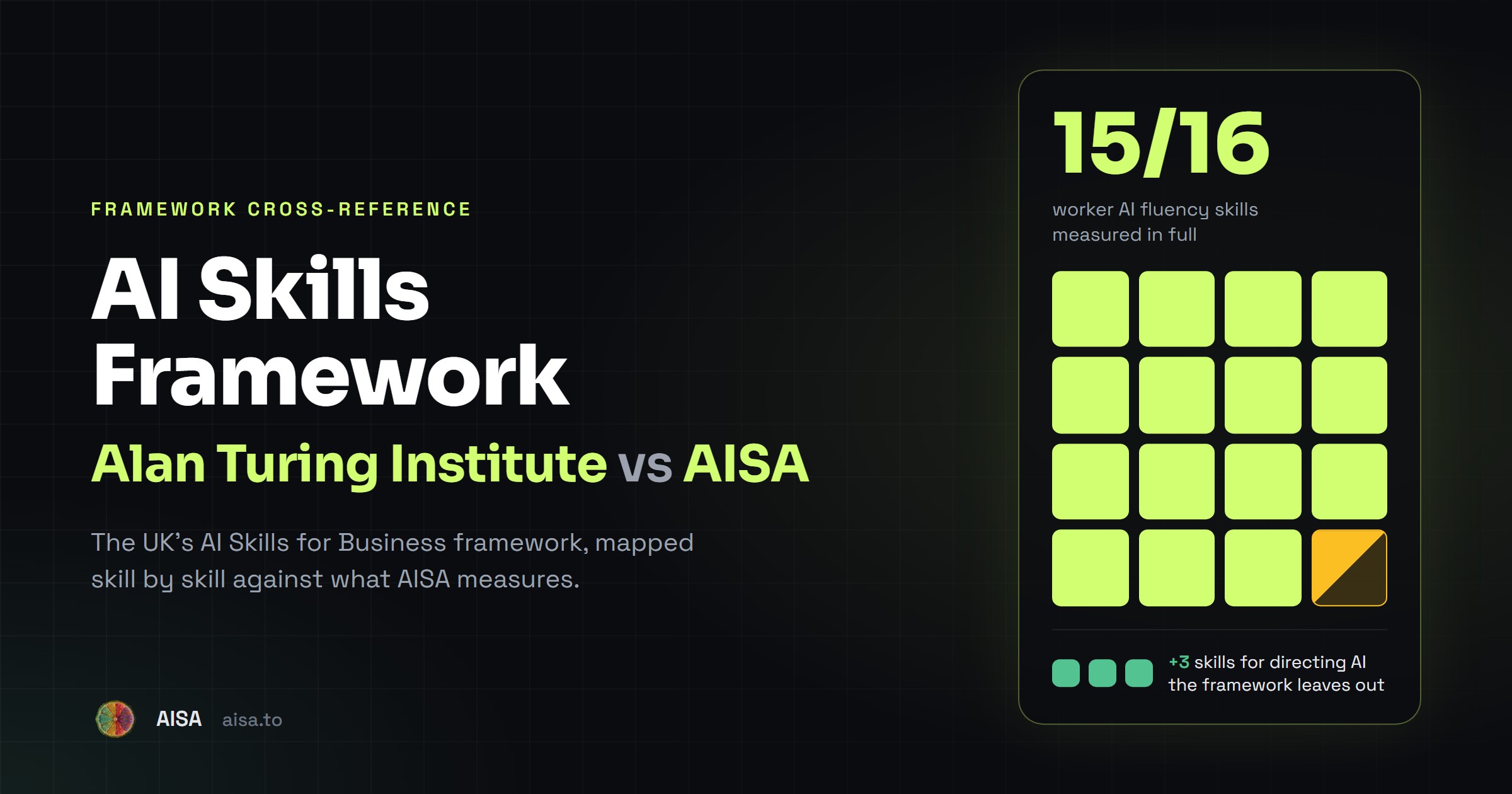
The Alan Turing Institute's AI skills framework mapped to AISA: 15 of its 16 worker AI fluency skills measured in full, plus the skill it leaves out.
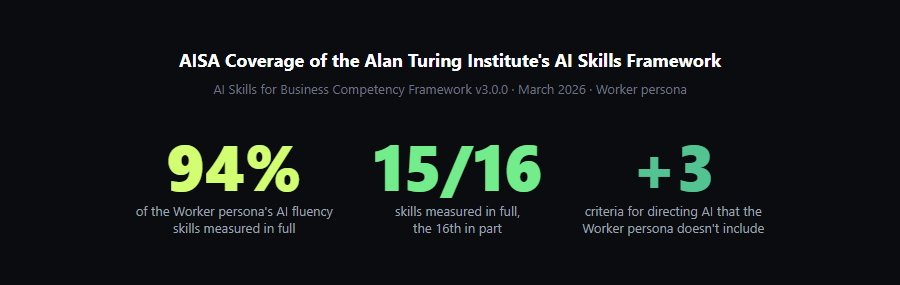
The Alan Turing Institute's AI skills framework sets out what people need to know, do and value to work with AI, and it is sponsored by the UK government. It is the third independent framework we have cross-referenced against AISA. We mapped every statement in its Worker persona, the profile for anyone who uses AI in their job, to AISA's published rubric. AISA measures 15 of the 16 AI fluency skills it describes in full and the 16th in part, and it measures a whole set of skills the Worker persona leaves out: directing AI.
The first two comparisons were Anthropic's AI Fluency Index, built from 9,830 real conversations, and the U.S. Department of Labor's AI Literacy Framework. This one adds the view of the UK's national institute for data science and AI. Below: what the framework is, which part of it describes AI fluency, how each skill maps to AISA, and where the two differ.
What Is the Alan Turing Institute's AI Skills Framework?
The AI Skills for Business Competency Framework is a public map of the AI skills a workforce needs. It is published by The Alan Turing Institute and sponsored by the Department for Science, Innovation and Technology (DSIT) through Innovate UK's BridgeAI programme. Version 3.0.0, released on 9 March 2026, describes 92 competencies across six personas.
Who It Is For
The framework is written for employers planning training and recruitment, for colleges and training providers designing courses, and for policymakers working on skills. It was developed with employers, educators and professional bodies through workshops and public consultation, and the work is led by Dr Matthew Forshaw, Senior Advisor for Skills at the Turing. The full framework is on Zenodo.
How the Framework Is Built
It works in layers, each one more specific than the last:
| Layer | What it describes | Example from the framework |
|---|---|---|
| Personas | Six ways people engage with AI: Citizen, Worker, Professional, Leader, Citizen Advocate, Change Champion | Worker: uses AI tools at work without being an AI specialist |
| Duties | What each persona is expected to do (41 in total) | "Apply professional judgement when interpreting AI outputs" |
| Competencies | The capabilities behind each duty (92 numbered) | "Interpret AI-driven outputs critically and apply professional judgement" |
| Knowledge, skill and behaviour statements | Each competency broken into units that can be taught and assessed | "Can evaluate AI outputs for accuracy, relevance, fairness, and appropriateness" |
Each competency carries one proficiency level, from 1 (Remember) to 6 (Create), based on Bloom's taxonomy. Version 3 also adds a four-stage AI project lifecycle, from framing a problem to retiring a system.
Which Part of the AI Skills Framework Describes AI Fluency?
The Worker persona does. It covers anyone who uses AI tools as part of their job without being an AI specialist, which is exactly who an AI fluency assessment is built for. Its 10 competencies break down into 86 knowledge, skill and behaviour statements.
Why the Worker Persona
The framework is clear that personas are not job titles: one person can be a Worker, a Change Champion and a Leader at once. The Professional persona describes people who build and run AI systems, with duties such as data pipelines, model monitoring and open-source contribution. The Leader persona describes strategy, procurement and governance. Those are job duties for engineers and executives. The Worker persona is the everyday profile every employee shares, so it is the fair comparison.
What Counts as AI Fluency
Not every Worker statement is about using AI well. We asked one question of each: does it need skill or judgement about AI itself, or is it a workplace duty that would apply to any tool? 57 statements describe the ability to use AI well. The other 29 describe workplace conduct, such as following company policy, escalating concerns, supporting colleagues and navigating role change. We list all 29 further down, with what each measures. We then grouped the 57 into 16 distinct skills, wherever several statements describe the same ability.
How the Framework's Worker Skills Map to AISA
AISA measures 15 of the 16 AI fluency skills in full, and the 16th, disclosing AI use, in part. Each skill maps to one or more of the 11 criteria in AISA's published rubric, and each is scored from 1 to 10 in a conversation rather than ticked off in a quiz.
| Turing Worker skill | AISA criteria | Alignment | How AISA measures it |
|---|---|---|---|
| Critically evaluate AI output before using or sharing it | Output Evaluation (T1) | Strongest match | Tested in live exercises where people decide whether AI output ships, gets fixed or stops: the framework's "correction, supplementation, or rejection" |
| Protect sensitive data when using AI | Safety & Responsibility (S1) | Direct match | From pasting anything (1–2) to stripping personal data before it reaches any AI tool (7–8), tested live with AI output that exposes personal data |
| Use AI in everyday work and existing workflows | Workflow Integration (W1) | Direct match | From one-off use (1–2) to workflows redesigned around AI (7–8) |
| Connect AI to other tools and automate routine work | W1, Task Decomposition (W2), Tool Landscape (U2) | Direct match | Up to agents, APIs and MCP integrations (U2 9–10) |
| Divide work between AI and human judgement | Task Decomposition (W2) | Direct match | This is W2 at 5–6; at 7–10 it adds feedback loops and verification gates between AI steps |
| Keep the human accountable: AI assists, it doesn't decide | S1, T1 | Direct match | S1 at 7–8 requires owning the outcome: "if this output causes harm, who's responsible?" |
| Recognise and act on ethical risks: bias, fairness, privacy | S1 | Direct match | Practised ethics, not theory: eloquence with no example of doing something differently scores low |
| Experiment with tools and features, and learn from it | Iterative Dialogue (P2), U2, learning agility | Direct match | Iteration as discovery (P2 9–10), and how quickly people learn, scored across the conversation |
| Curiosity and continuous learning | Learning agility | Direct match | Scored on five levels, from no learning signal to a systematic learning practice |
| Know what AI tools can do, where they fail, and that output varies | Limitation Awareness (T2), AI Fundamentals (U1) | Strong overlap | From naming headlines (3–4) to predicting failure on a new task before trying (7–8) and reasoning from how models work (9–10) |
| Judge AI output about other people: summaries, notes, colleagues' privacy | T1, S1 | Strong overlap | Live exercises put AI write-ups about people on the line, such as a survey summary that quotes respondents by name; S1 at 7–8 scores thinking about who is affected |
| Operate tools well and fix common issues | P2, Context & Memory (P3), U2 | Strong overlap | Scores how people debug the AI's misunderstanding, not just whether they can use the interface |
| Spot where AI can improve the work | W1, Domain Application (W3) | Strong overlap | W3 at 7–8 requires a new AI workflow in their own field, not generic use |
| Adapt as tools and your role change | W1, learning agility | Strong overlap | Scores the trajectory of someone's AI use, not just where it is today |
| Encourage responsible use and raise concerns | S1 | Strong overlap | S1 at 8–10: shapes how others use AI responsibly, from team norms to written policy |
| Be open about AI's role in your work | S1 | Partial | Scored within S1 when it comes up: flagging AI-assisted work so reviewers know to check it (7–8), and whether stakeholders know where AI contributed (9–10) |
| Not in the Worker persona: directing AI | Prompt Design (P1), P2, P3 | AISA goes further | Prompts appear once in 86 Worker statements, as something to experiment with; nothing covers structuring a request, refining it through follow-ups or managing context |
The framework statement codes behind each skill are in the full mapping table.
The Strongest Match: Judging AI Output
The framework asks workers to "identify when outputs require correction, supplementation, or rejection". AISA tests this live: people see AI output that is about to go out, decide whether it ships, gets fixed or stops, and explain why. It is also where most people struggle. In the AISA AI Fluency Index, November 2026, only 11.7% of professionals score 7 or more out of 10 on output evaluation. Our critical thinking guide shows how to build the skill, starting with hallucination detection.
Safety Sits Inside the Work
Six of the 16 skills land on AISA's Safety & Responsibility criterion: protecting sensitive data, keeping the human accountable, acting on ethical risks, judging AI output about other people, encouraging responsible use and being open about AI's role. AISA scores these as practice, not opinion: someone who can discuss bias eloquently but cannot name one thing they do differently because of it scores low. The top bands ask for what the framework calls Create, its highest level: building checks, policies or practices that other people follow. Two places to start are AI data privacy and keeping a human in the loop.
The One Partial: Disclosing AI Use
The framework asks workers to be transparent about AI's role in what they produce: to recognise when the people relying on a piece of work need to know AI contributed, and to tell them. AISA scores this within Safety & Responsibility whenever it comes up, for instance when someone flags AI-assisted work so a reviewer knows to check it differently. The Turing framework makes a good case for asking every person about it directly, and that is the next sharpening of AISA's Safety dimension. Our responsible AI use guide and the entry on AI transparency practices cover the habit in practice.

Curious about your AI Fluency?
AISA helps you measure, prove and improve your AI skills — free report in a 20–40 minute chat.
Where AISA Goes Beyond the AI Skills Framework
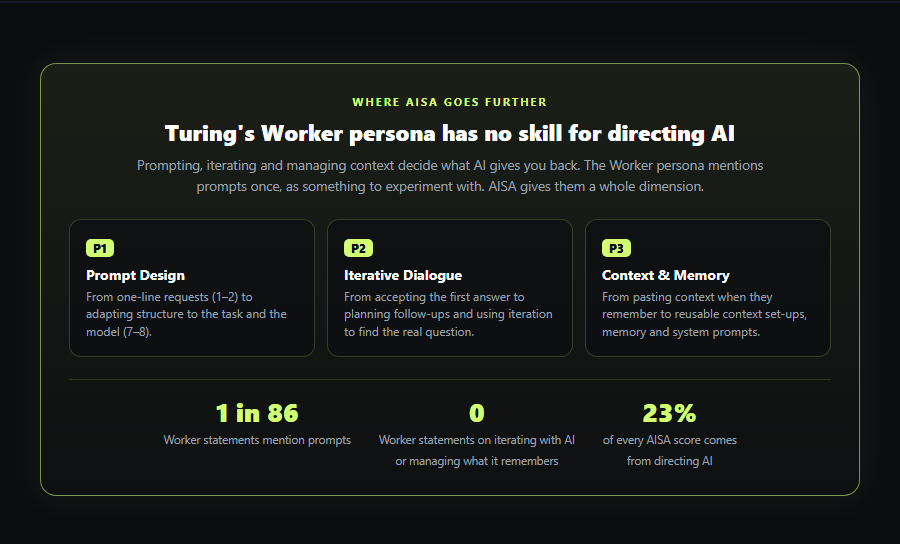
AISA measures how well people direct AI, which the framework's Worker persona does not cover. Across its 86 statements, prompts appear once, as something to experiment with, and none covers refining a request through follow-ups or managing what the AI knows. AISA scores all three, and together they make up 23% of every AISA score.
Directing AI Is a Skill Most People Have Not Mastered
Directing AI covers three AISA criteria: Prompt Design, Iterative Dialogue, and Context & Memory Management. They decide what AI gives you back, and they are scarce. In the November 2026 Index, only 12.2% of professionals score 7 or more on iterative dialogue, 16.1% on prompt design and 20.8% on context and memory. Anthropic's study found iteration to be the strongest single sign of fluent AI use, and the Department of Labor gives directing AI a whole content area of its own. Iterative refinement and context engineering are good places to start, and the prompting skills guide has exercises for every level.
Choosing the Right Tool, and Knowing How AI Works
The framework gives these skills to other personas. Matching AI tools to tasks sits with the Change Champion, and the idea that AI systems "learn from data patterns, not human reasoning" sits with the Citizen. The Worker persona gets the "basic capabilities and limitations" of its tools. AISA measures both for everyone, through its AI Fundamentals and Tool Landscape criteria, and the data shows why: 45% of professionals score 4 or below out of 10 on AI fundamentals.
A Score on a Scale, Not a Single Target
The framework sets one proficiency level per competency: interpreting AI output critically, for example, is pitched at level 5, Evaluate. AISA places each person on a 1 to 10 scale for every criterion, from Novice to Expert, so an employer can see how far someone sits below or above the bar. AISA's top bands match the framework's highest level: an Expert does not just check AI output well, they design the checks other people use.
Evidence From What People Do
The framework notes that some skills "must be acquired through practice in real situations", and it aims for "clearly evidenced workplace-relevant capability". AISA is built the same way. It is a 20 to 40 minute conversation with live exercises, and every score is tied to what the person said or did in it.
The Other 29 Statements: Professional Skills, Not AI Fluency
29 of the 86 Worker statements describe how people conduct themselves at work around AI. They matter to an organisation, but they measure compliance, workplace process, organisational and career skills rather than the ability to use AI well. Someone can be excellent at all of them with any tool.
What They Cover
| Turing statements | What they measure | Kind of skill | Why it isn't AI fluency |
|---|---|---|---|
| Navigate role change | Understanding how AI may change jobs, joining workforce and reskilling conversations, openness to role change | Career and change | Attitudes to career change and workforce planning |
| Contribute to organisational learning | Feeding into improvement processes, taking part in reskilling programmes, raising concerns constructively | Organisational development | Taking part in the organisation's learning, not an individual's ability with AI |
| Share learning and support colleagues | Sharing tips and lessons from AI use, helping colleagues gain confidence | Peer support | A coaching and champion role; teaching others is a different ability from using AI well |
| Escalate through the right channels | Knowing who to tell, and raising questionable output or ethical issues with managers, technical teams or ethics leads | Workplace process | Knowing an organisation's reporting routes; spotting that output needs a second look is scored separately |
| Make shared AI use inclusive and accessible | Making sure AI in meetings and teams doesn't disadvantage colleagues with different voices, accents or roles | Inclusion | Inclusive workplace practice, which applies to any tool a team adopts |
| Use only approved tools | Choosing internal over external platforms when policy requires it, and defaulting to the approved list | Compliance | Following an organisation's tool list, not skill with the tools |
| Feed back on AI tools and practices | Giving constructive feedback on collaboration tools and team practices | Organisational improvement | Contributing to how the organisation improves its tools, not using them |
| Know and follow company AI and data policies | Knowing your organisation's rules and data protection law such as GDPR, and applying them consistently | Compliance | Rule-following and legal knowledge that applies to email, spreadsheets or any other system |
| Tell human-written from AI-assisted work | Judging the likely origin of a piece of content | Content verification | A detection skill about other people's AI use, not one's own |
Where These Skills Belong
These are duties an employer sets and coaches through policy, process and culture, and the framework's own Change Champion persona collects many of them. An AI fluency score tells you who can do the work with AI. These skills describe how someone carries that work inside your organisation.
Asked vs Measured: Why an AI Skills Framework Needs an Assessment
A framework defines what good looks like; an assessment tells you whether a person has it. The Turing framework is designed for planning training, recruitment and curricula, and lists assessment design among its uses. AISA is the measurement layer.
What the UK Measures Today
Most workforce data on AI skills is self-reported. The UK government's AI Skills for Life and Work research, carried out by Ipsos with the Turing as a project partner and published in January 2026, found that 21% of people in work feel confident using AI in the workplace. That is a measure of confidence, not of skill.
What Measurement Adds
Confidence and skill come apart. Before each AISA assessment, people predict their score. In the November 2026 Index, built on nearly 3,400 assessments, three in four overestimate it, by 18 points on average, and the average professional scores 46 out of 100. We set the major 2026 surveys side by side in AI in the Workplace Statistics, and tested Anthropic's interview findings against measured data in Anthropic Found What's Holding AI Back.
How to Use the Framework With AISA
Use the framework to decide what each role needs. Use an AI readiness assessment to find out where each person stands today, skill by skill, and where training will move the score. For a single team, a team AI assessment gives a baseline per person and per dimension, and anyone can take the AI fluency assessment to see their own.
Three Independent Frameworks, One Assessment
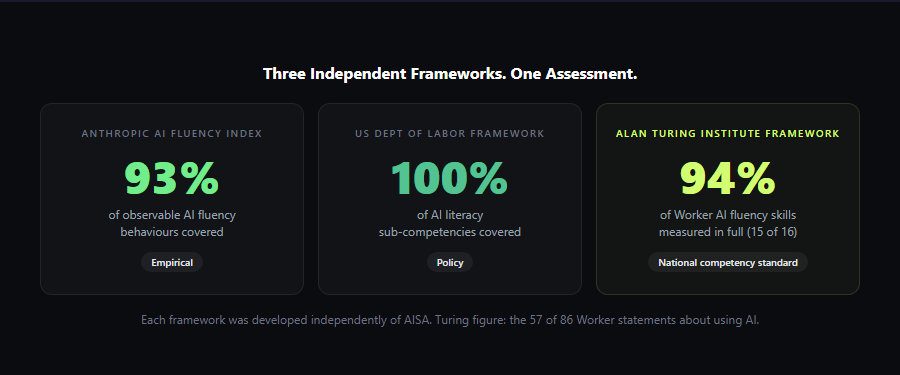
Anthropic's AI Fluency Index, the U.S. Department of Labor's AI Literacy Framework and the Alan Turing Institute's AI skills framework were built independently: by an AI lab from 9,830 conversations, by a federal government as workforce guidance, and by the UK's national institute for data science and AI with employers and educators. AISA covers 93%, 100% and 94% of them respectively.
What They Agree On
All three treat judging AI output as core, and the two that describe skills directly, the Department of Labor's and the Turing's, both make responsible use a core requirement. Anthropic and the Department of Labor also put directing AI at the centre, which is where AISA goes further than the Turing Worker persona.
Check the Mapping Yourself
Every skill, every statement code and every AISA criterion is in the full table: Alan Turing Institute skill to AISA criterion. The same tables exist for Anthropic and the Department of Labor, and the methodology page brings all three together.
Related reading: AISA vs Anthropic's AI Fluency Study Compared: the 9,830-conversation study, mapped criterion by criterion. Related reading: AI Fluency vs AI Literacy: The DOL Standard: all 25 Department of Labor sub-competencies, mapped. Related reading: AI Skills Gap Statistics: where measured AI skills fall short, role by role.
Frequently Asked Questions
What is the Alan Turing Institute's AI skills framework?
It is the AI Skills for Business Competency Framework, published by The Alan Turing Institute and sponsored by the UK's Department for Science, Innovation and Technology through Innovate UK's BridgeAI programme. Version 3.0.0, released in March 2026, sets out 92 competencies across six personas, from everyday AI users to leaders, each broken into knowledge, skill and behaviour statements.
Does AISA measure the skills in the Turing AI skills framework?
Yes. AISA measures 15 of the 16 AI fluency skills in the framework's Worker persona in full, and the 16th, disclosing AI use, in part. It also measures how well people direct AI (prompting, iterating and managing context), which the Worker persona does not cover.
What is the difference between an AI skills framework and an AI skills assessment?
An AI skills framework describes what people should know and be able to do. An AI skills assessment measures whether a particular person can do it, and how well. The Turing framework is built for planning training and recruitment; AISA scores each skill from 1 to 10 in a conversation, with every score tied to evidence.
Which AI skills does the Turing framework expect from every worker?
Its Worker persona expects people to use AI tools confidently, judge AI output critically, protect sensitive data, act on ethical risks, experiment responsibly, build AI into workflows and adapt as their role changes. It also expects people to be open about AI's role in their work, alongside workplace duties such as following policy and escalating concerns.
Independence note: AISA was designed independently of the AI Skills for Business Competency Framework. The Alan Turing Institute, Innovate UK and the Department for Science, Innovation and Technology do not own, endorse, accredit or contribute to AISA. The framework is publicly available. This comparison is our own analysis of how AISA's published rubric maps to the framework's Worker persona.
Source: The Alan Turing Institute, Innovate UK, Department for Science, Innovation and Technology, Digital Catapult, Science and Technology Facilities Council, British Standards Institution and Alliance for Data Science Professionals. AI Skills for Business Competency Framework (3.0.0), 9 March 2026. Zenodo.

Ozan Dagdeviren
Founder of AISA — the AI skills assessment platform used by professionals worldwide to measure, certify, and develop their AI fluency. More about AISA
Curious about your AI Fluency?
AISA helps you measure, prove and improve your AI skills — free report in a 20–40 minute chat.