What is AI fluency?
AI fluency is the ability to work with AI effectively, safely, and adaptably — across tools, across contexts, and under pressure. It goes beyond knowing what AI is (literacy) and beyond using one tool (competence). A fluent professional integrates AI into how they think and work.
This page defines AI fluency precisely, breaks it into its five measurable dimensions, maps the four proficiency levels with real score data from >1,800 assessed professionals, and explains how it differs from AI literacy.

Founder, AISA · Updated August 2026
AI fluency explained: the language analogy
Think about learning a second language. You start with grammar rules and vocabulary — you can read and understand, maybe hold a simple conversation. That is literacy. Fluency comes when you stop translating in your head and start thinking in the language.
The same progression applies to AI. A literate user can write a ChatGPT prompt and get a usable response. A fluent user designs multi-turn conversations, manages context across sessions, chooses different models for different tasks, and catches errors before they cause problems — not because they follow a checklist, but because these habits are internalised.
Most professionals today sit between literate and fluent. They use AI, sometimes daily, but accept output at face value, use one tool for everything, and haven't thought about data boundaries or when AI should not be trusted. The gap between literate and fluent is where both career differentiation and organisational value concentrate.
Why AI fluency matters now
Three forces are converging to make AI fluency a career-defining skill in 2026.
For individuals: AI fluency is becoming the divide between professionals who use AI as a search engine and those who use it as a thinking partner. Data from 1,800+ AISA assessments shows that fluent professionals (score 60+) don't just use AI more — they use it differently. They decompose problems before prompting, verify outputs against domain knowledge, and build repeatable workflows. These habits compound: a fluent professional doesn't just save time, they produce work that wouldn't have been possible without AI collaboration. According to McKinsey's 2025 State of AI report, 72% of organisations now use AI in at least one business function — but the gap between adoption and effective use is where most teams stall.
For organisations: Hiring and upskilling decisions increasingly depend on measuring AI capability, not just declaring it. The EU AI Act (Article 4) requires that all staff interacting with AI systems have "a sufficient level of AI literacy." But literacy is the floor, not the ceiling. Organisations that measure and develop AI fluency — not just check a compliance box — build teams that can adapt as tools and techniques change quarterly.
For the market: The AI skills landscape is moving from "do you use AI?" to "how well do you use AI?" Self-reported skill claims on resumes and LinkedIn profiles are unreliable — AISA's data shows professionals overestimate their AI skills by an average of 18.5 points. Objective measurement is becoming table stakes for credible hiring and L&D decisions.
The four levels of AI fluency
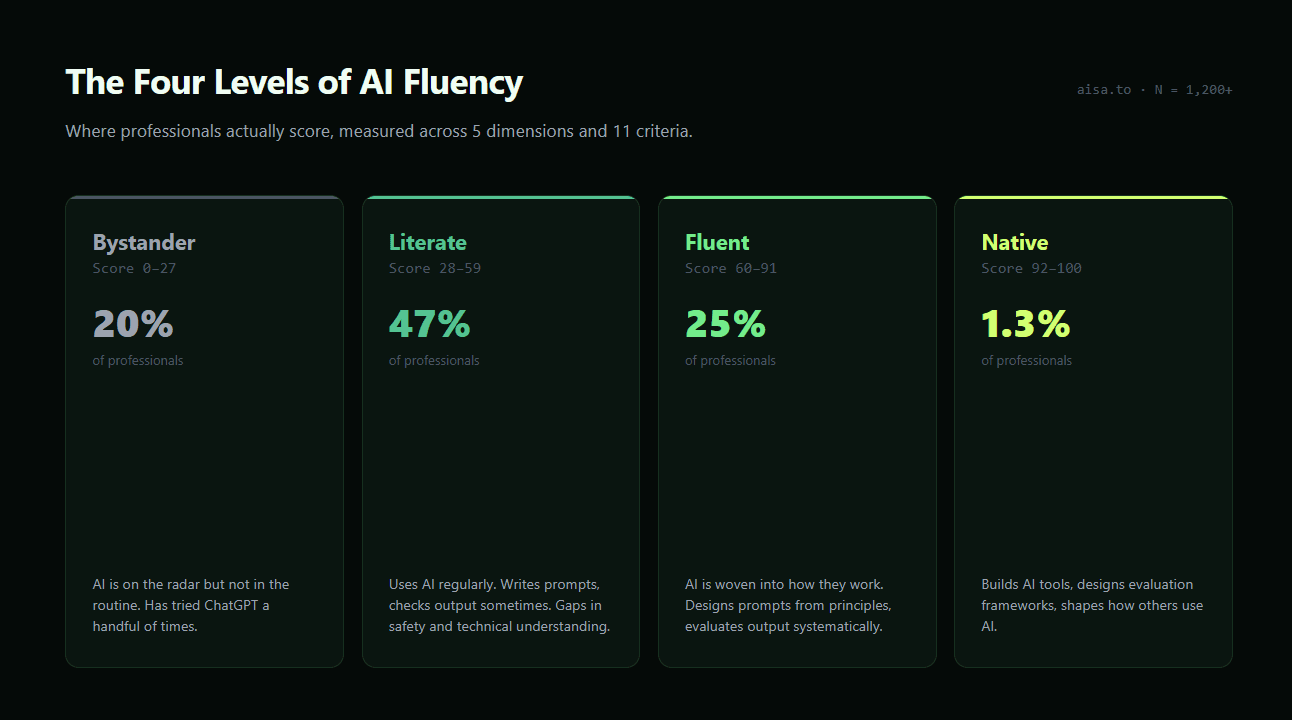
AISA defines four levels based on measured behaviour, not self-assessment. Each level maps to a score range from the AISA AI Fluency Index (N=1,200+).
| Level | Score | % of professionals | What it looks like |
|---|---|---|---|
| Bystander | 0–27 | 20% | AI is on the radar but not in the routine. Has tried ChatGPT a few times. |
| Literate | 28–59 | 47% | Uses AI regularly. Writes prompts, checks output sometimes. Gaps in safety and technical understanding. |
| Fluent | 60–91 | 25% | AI is woven into how they work. Designs prompts from principles, evaluates output systematically, switches between tools. |
| Native | 92–100 | 1.3% | Builds AI tools, designs evaluation frameworks, shapes how others use AI. |
The median score across 1,200+ assessed professionals is 48 out of 100 — squarely in the Literate range. Because the sample is self-selected (people curious enough to take an assessment), the true workforce average is likely lower.
The five dimensions of AI fluency
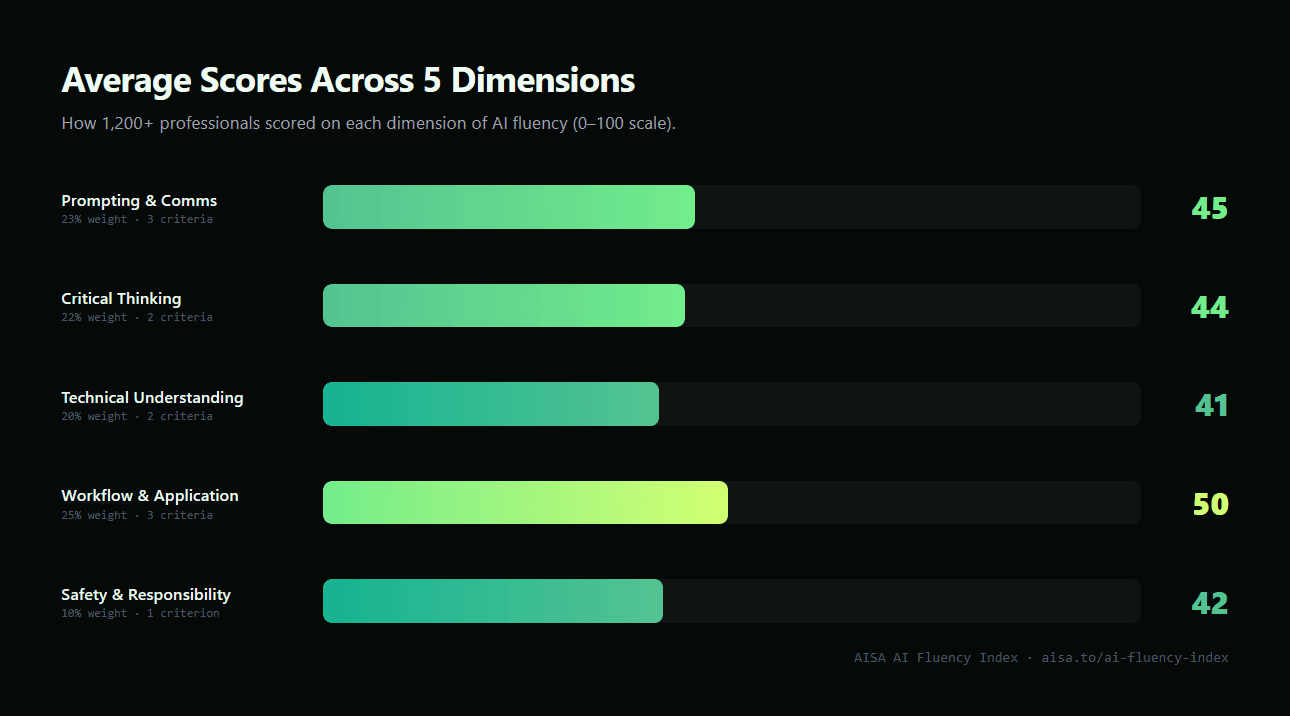
AI fluency is not a single skill. It breaks into five dimensions, each scored independently against AISA's published rubric across 11 criteria.
Prompting & Communication (23% weight)
How you structure instructions, iterate on output, and manage context across conversations. Average score: 45 out of 100 — held back by weak context management and generic follow-ups.
Critical Thinking (22% weight)
Whether you evaluate AI output or accept it at face value. Recognising hallucinations, understanding model limitations from experience, adjusting scrutiny based on stakes. Average: 44.
Technical Understanding (20% weight)
How AI works: tokens, context windows, temperature, model differences. The lowest-scoring dimension at 41 — a knowledge gap that leads to poor tool choices and unrealistic expectations.
Workflow & Application (25% weight)
How deeply AI is integrated into your work. Not occasional use, but load-bearing integration. Includes task decomposition — knowing which parts to delegate. The highest-scoring dimension at 50.
Safety & Responsibility (10% weight)
Data boundaries, risk awareness, downstream impact. Score 7+ requires going beyond personal caution into team norms and systemic risks. Average: 42.
The 11 criteria
Each dimension breaks into specific, measurable criteria — 11 in total. Each criterion is scored 1–10 based on evidence from your conversation:
| Dimension | Criteria |
|---|---|
| Prompting | P1: Prompt Design · P2: Iterative Dialogue · P3: Context & Memory Management |
| Critical Thinking | T1: Output Evaluation · T2: Limitation Awareness |
| Technical | U1: AI Fundamentals · U2: Tool Landscape |
| Workflow | W1: Workflow Integration · W2: Task Decomposition · W3: Domain Application |
| Safety | S1: AI Safety & Responsibility |
The full scoring methodology — what each score band looks like in practice, with calibration rules and evidence hierarchy — is published in the AISA Rubric.
What AI fluency looks like in practice
The difference between a Literate and a Fluent professional isn't about knowing more tools — it's about how they approach AI work:
| Situation | Literate (score 28–59) | Fluent (score 60–91) |
|---|---|---|
| Writing a prompt | Types a question and accepts the output | Structures role, context, constraints, and output format — can explain why each element is there |
| Bad output | Retries with a different phrasing or gives up | Diagnoses why the output failed, adjusts the specific element, references the prior output |
| Choosing a tool | Uses whichever AI tool they know best | Selects based on the task — knows when to use an API vs chat, when a smaller model is better, when to use RAG vs fine-tuning |
| Verifying output | "Looks right to me" | Checks facts against sources, probes edge cases, applies verification checklists calibrated to the stakes |
Cross-referenced: 93% overlap with Anthropic's AI Fluency Index
In 2026, Anthropic published their AI Fluency Index, analysing 9,830 conversations to identify what AI fluency looks like in practice — the largest empirical study of AI fluency ever published.
When mapped against AISA's rubric, 93% of the behaviours Anthropic identified were already being measured. Their top markers — iteration ability, directive behaviours, evaluative gaps — align directly with AISA's Prompting, Critical Thinking, and Workflow dimensions.
The two frameworks are complementary. Anthropic defines the behaviours from usage data. AISA provides the measurement instrument that scores them. The key difference: Anthropic measured how people use AI (a usage study); AISA measures how professionals score on assessed fluency (a benchmark).
AI fluency vs AI literacy
The terms get used interchangeably. They shouldn't.
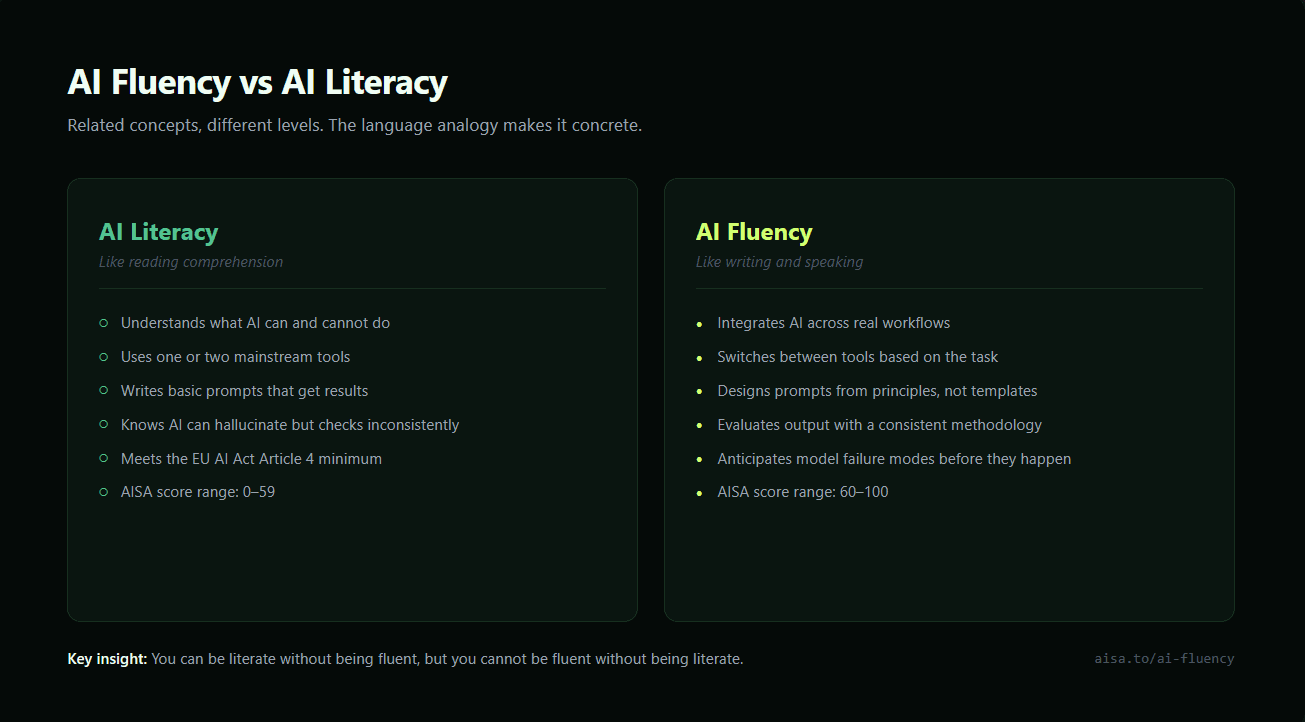
AI literacy is the knowledge layer — understanding how AI works, its capabilities, and its risks. The EU AI Act Article 4 mandates AI literacy for all staff interacting with AI systems.
AI fluency builds on literacy by adding application. Can you integrate AI into real workflows? Can you iterate on output rather than accepting the first response? Can you reason about why a model behaves the way it does?
The language analogy: literacy is reading comprehension. Fluency is writing and speaking. You can be literate without being fluent, but you cannot be fluent without being literate. For the full breakdown including proficiency, see the dedicated comparison.
How to measure AI fluency
Self-assessment doesn't work. AISA's data shows professionals overestimate their AI skills by an average of 18.5 points on a 100-point scale. A 2026 academic study found that self-reported AI literacy measures show “low correlation” with objective measures — and that people who rate themselves highest actually score lower on standardised tests.
Multiple-choice quizzes can screen for literacy (do you know what a large language model is?) but cannot measure fluency. Fluency requires demonstrating how you apply knowledge — structuring a prompt under constraints, iterating when the first output is wrong, choosing the right tool for a specific task. Static tests can't observe any of this.
AISA uses a conversational approach: a 20-minute conversation with an AI facilitator, scored independently by a separate AI evaluator against the published rubric. No multiple-choice questions — you demonstrate your skills in real time. The result is a scored profile across all 11 criteria, a persona classification, and specific growth recommendations.
Every completed assessment issues a free AI certificate recording the level reached — verifiable, valid for 12 months, and addable to LinkedIn in one click. Nothing to unlock, no card required.
For organisations, the same assessment works at team scale. The team assessment provides aggregate data by role, department, and seniority — showing where training budget should go and measuring whether it worked. Pre- and post-training measurement uses the same rubric, so the comparison is apples-to-apples.
How to build AI fluency
AI fluency isn't built in a course — it's built through deliberate practice with feedback. The professionals who score at the Fluent and Native levels share three habits:
1. Use AI daily, on real work. Not side experiments — actual deliverables. Every task is a chance to practise structured prompting, iterative refinement, and output evaluation. The assessment data shows that daily AI users score 15 points higher on average than weekly users — but only if they're using AI intentionally, not just as a search bar.
2. Learn the "why," not just the "how." Understanding how tokens work, why temperature affects output, and what the difference between fine-tuning and prompting actually means gives you a mental model that transfers across tools. This is why Technical Understanding is a separate dimension — it's the foundation the other four build on.
3. Measure, don't guess. The 18.5-point overestimation gap means self-assessment isn't a growth strategy — it's a comfort blanket. Take an objective AI fluency test, see where you actually stand, and use the dimension-level breakdown to target your weakest area. Then measure again in 3–6 months to see if the gap closed.

Curious about your AI Fluency?
AISA helps you measure, prove and improve your AI skills — free report in a 20-minute chat.
Related reading:
- The AISA AI Fluency Index — quarterly benchmark report with full score distributions.
- AI Literacy vs Proficiency vs Fluency — how the three terms map to score ranges.
- How Good Are People at AI? 1,103 Tested — full benchmark breakdown by role and industry.
Frequently asked questions
What does AI fluency mean?
AI fluency is the ability to work with AI effectively, safely, and adaptably — across tools, contexts, and stakes. It goes beyond knowing what AI is (literacy) to integrating AI into how you actually work: structuring prompts, evaluating output critically, choosing between tools, and adapting your approach based on the task.
What are the levels of AI fluency?
AISA defines four levels: Bystander (score 0-27, AI is on the radar but not in the routine), Literate (28-59, uses AI regularly but with gaps), Fluent (60-91, AI is a natural extension of how they work), and Native (92-100, builds AI systems, shapes practice). The median score across 1,200+ assessed professionals is 48 — squarely in the Literate range.
How is AI fluency different from AI literacy?
AI literacy is the knowledge layer — understanding how AI works, its capabilities, and its risks. AI fluency adds application: integrating AI into workflows, iterating on output, adapting to new tools, and reasoning about model behaviour. The language analogy makes it concrete: literacy is reading comprehension, fluency is writing and speaking.
Can you measure AI fluency?
Yes. Self-reported surveys correlate poorly with actual ability. The most reliable method is a conversational assessment where professionals demonstrate skills in real time, scored against a published rubric. AISA measures 11 skills across 5 dimensions in a 20-minute conversation and produces a scored profile with growth recommendations.