AI Hype vs Reality: The Jetsons Problem
AI hype vs reality: the replacement story wins because it feels exciting, not because it is true. What 1,628 assessments show about who gains from AI.
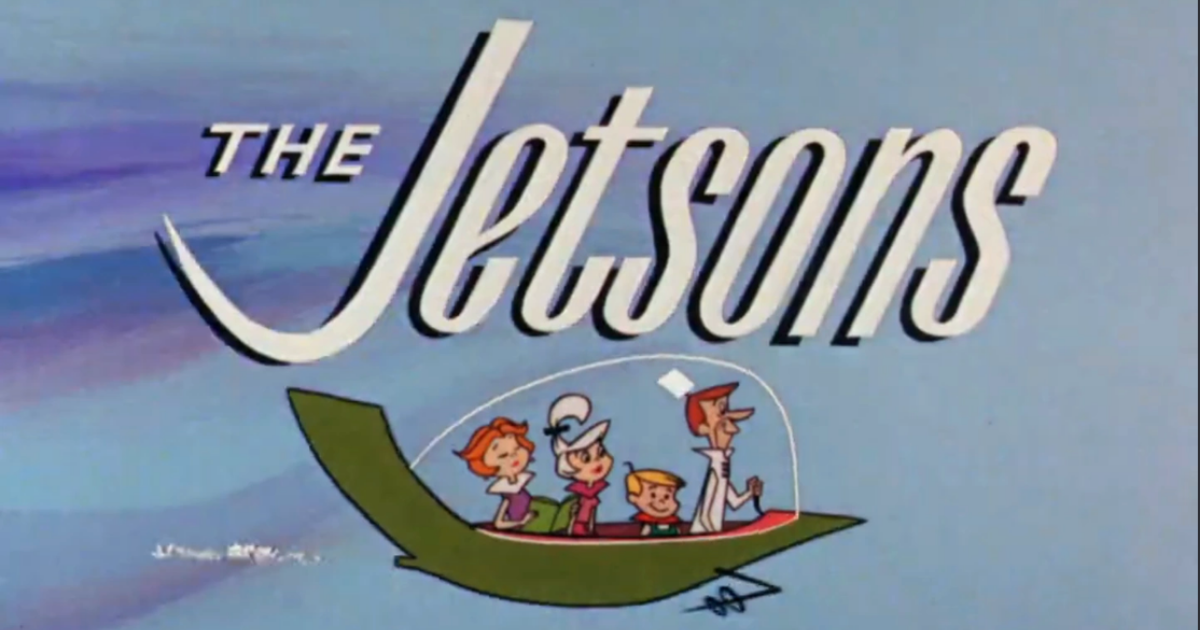
Do you remember The Jetsons? I think that cartoon shaped more technology decisions than most of the research literature written since. That sounds like a throwaway line about AI hype vs reality, but I mean it literally. A show that ABC cancelled after 24 episodes has done more to set our expectations of the future than any careful account of how work actually changes.
It premiered on 23 September 1962, the first programme ABC ever broadcast in colour, and it flopped. One season. Syndication in the 1980s then turned it into the default mental image of "the future" for three generations. Flying cars. A robot maid. A man who pushes a single button for a living and complains about the workload.
Sixty-four years later we are having the same argument about AI, in exactly the same shape.
AI Hype vs Reality: Why the Replacement Story Always Wins
The gap between AI hype and reality is not an information problem. It is a motivation problem. We do not pick our picture of the future by weighing evidence and choosing the most probable one. We pick the version that is most exciting to anticipate, and we assemble the evidence afterwards.
Our inner machinery does not run on logic. It runs on motivation, and motivation runs on the dopaminergic system, which behaves very differently from the pop-science version. In 1997, Wolfram Schultz, Peter Dayan and Read Montague published A Neural Substrate of Prediction and Reward in Science, showing that dopamine neurons do not fire for reward. They fire for unexpected reward. They encode the error between what you predicted and what actually arrived.
That single finding explains most of the AI discourse.
The system driving our attention is tuned to the distance between the expected and the imagined. A future that looks like a slightly better version of today produces almost no signal. A future full of intelligent machines doing the work produces a great deal of it. So we gravitate towards the versions of the future that exploit this mechanism hardest: not the most sensible, not the most beneficial, not the most workable, but the most future-like in the childish sense. The one that looks least like now.
"AI replaces human workers" is that story. It is not a forecast. It is a Jetsons episode. And it will beat any sober account of how tools and skills interact, for the same reason a robot maid beat labour economics in 1962.
The tell: hype is always about substitution, never about skill
You can spot the pattern by what gets left out. Substitution stories require no craft, no learning curve, no operator. The machine simply does the thing.
Any version of the future that requires a human to get good at something is less exciting by construction, because "you will have to practise" is not a reward your brain anticipates. It is homework. This is why the utopian and dystopian camps sound so similar when you strip the sentiment out. Both assume the human is being removed from the loop. They only disagree about whether that is a holiday or a catastrophe.
What the Data Says About AI Replacing Human Workers
The credible forecasts do not describe replacement. They describe churn. The World Economic Forum's Future of Jobs Report 2025 projects 92 million jobs displaced by 2030 and 170 million created, a net gain of 78 million, alongside 39% of workers' core skills changing inside five years.
That is a genuinely disruptive number. It is just disruptive in a different direction than the story predicts. Nothing in it says "the machines take over." It says the composition of work churns hard and the skill requirements underneath it churn harder. The same report names the skills gap as the single biggest barrier to transformation, cited by 63% of employers.
Churn is a worse story and a better description. It has no robot maid in it. It has re-skilling, which is slow, uneven, and hard to put in a trailer. If you want the personal version of this question rather than the macroeconomic one, I wrote about which skills actually protect you separately.
AI Is a Tool, and Output Is the Tool Times the Operator
Here is the unglamorous reality. AI is a tool. The output of a tool is set by two things: the instrument itself and the skill of the person holding it. The same model, on the same day, produces a sharp piece of analysis for one person and generic filler for another. That difference has a name, AI fluency, and it can be measured.
It is basically a camera. Same sensor, same lens, wildly different photographs.
The important part is that these two terms multiply rather than add. A very capable model in the hands of someone with no technique does not produce slightly worse results than it would with an expert. It produces something categorically different, because every decision about what to ask, what to check, what to discard and what to do next is being made badly. Model capability raises the ceiling. Only fluency gets you near it.
This is also why "the models will keep improving, so skill will stop mattering" gets it backwards. Every capability increase widens the distance between the person who can operate at the frontier and the person who cannot. The ceiling rises. The floor does not move on its own.
There is a fuller definition of what fluency means in practice on our AI fluency pillar page, and a longer walk through the concept in What Is AI Fluency.
Where AI Slop Actually Comes From
AI slop is not what happens when models fail. It is what happens when capable models meet operators who never verify. Anthropic's AI Fluency Index analysed 9,830 extended conversations and found "iterates and refines" present in 85.7% of them, while "checks facts and claims that matter" appeared in only 8.7%.
Sit with those two numbers next to each other. Almost everyone pushes back and forth with the model. Almost nobody checks whether the thing they are refining is true. Only 10.1% of conversations involved consulting the AI on the approach before executing.
That is the slop factory, described precisely. Iteration without verification is not craft. It is polishing an object you have not inspected. The output gets smoother with every pass and no more correct.
Slop is a skill signature, not a model defect
The behaviours that separate good operators from slop producers are unglamorous and learnable: hallucination detection, running an actual verification checklist rather than a vibe check, and treating iterative refinement as a way of interrogating an answer rather than sanding it down.
The failure mode underneath all of them has a name too. Cognitive surrender is the moment you stop evaluating and start accepting, and it does not announce itself. It feels like efficiency.
We cross-referenced our own rubric against Anthropic's findings in this comparison, and the overlap is high enough that I am fairly confident this is a stable picture of how people actually work with AI rather than an artefact of one dataset.

Curious about your AI Fluency?
AISA helps you measure, prove and improve your AI skills — free report in a 20–40 minute chat.
AI Hype vs Reality, Measured: The Self-Assessment Gap
The clearest evidence that the story distorts judgement is what happens when you ask people to predict their own score before you measure it. Across 718 AISA assessments where the candidate predicted first, the average prediction was 62.1 and the average measured result was 43.9. A gap of 18.2 points on a 100-point scale.
Then it gets more interesting. The gap tracks enthusiasm.
Among people who told us AI will transform everything, the average prediction was 68.3 and the measured average was 49.6, a gap of 18.7 points. Among the more measured group who called AI merely "useful", the prediction was 55.7 against a measured 39.4, a gap of 16.3.
Note what that does and does not say. The enthusiasts genuinely score higher, 49.6 against 39.4. Excitement about AI does correlate with real ability, which is worth saying plainly. But the same enthusiasm inflates the self-estimate faster than it lifts the skill. The more vivid your picture of the future, the further your sense of your own position drifts from where you actually stand.
Confidence rises with distance from the practice
By group, the pattern is stark.
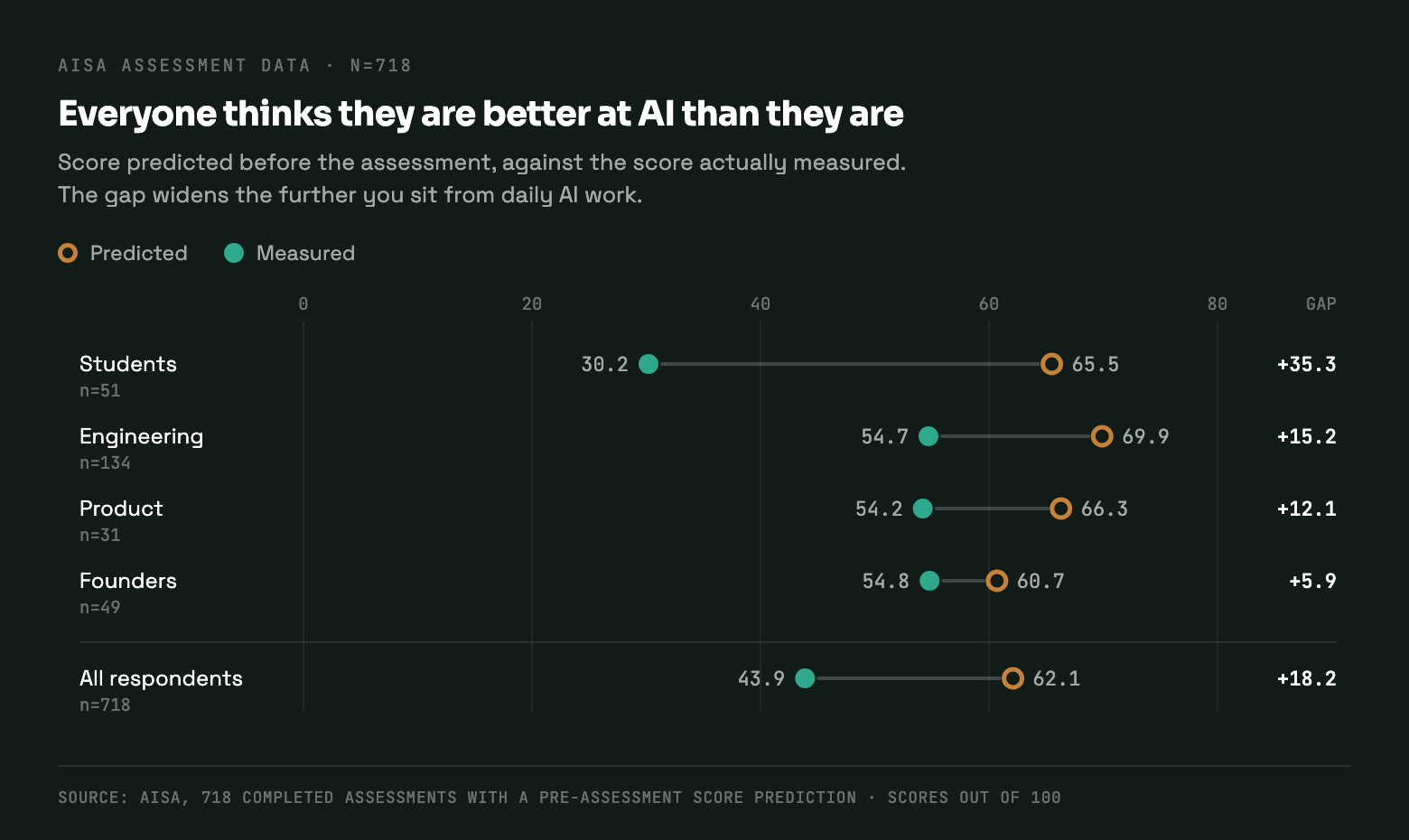
Students, the group with the least professional exposure to real AI work, hold the most confident forecast and the largest gap by a wide margin. Founders, who tend to have been personally burned by an AI project that did not work, are almost calibrated. Product managers land closer than most, which we looked at in more depth here.
This is the Jetsons effect rendered as a spreadsheet. Distance from the practice increases confidence in the story.
What Fluency Looks Like When You Measure It Instead of Arguing About It
Across 1,628 completed assessments, the average composite score is 46.9 out of 100 and the median is 47. This is not a population of AI natives, and it is not a population of refuseniks. Most people are competent in patches and unaware of which patches they are missing.
The five dimensions we score sit closer together than you might expect, with one clear laggard.
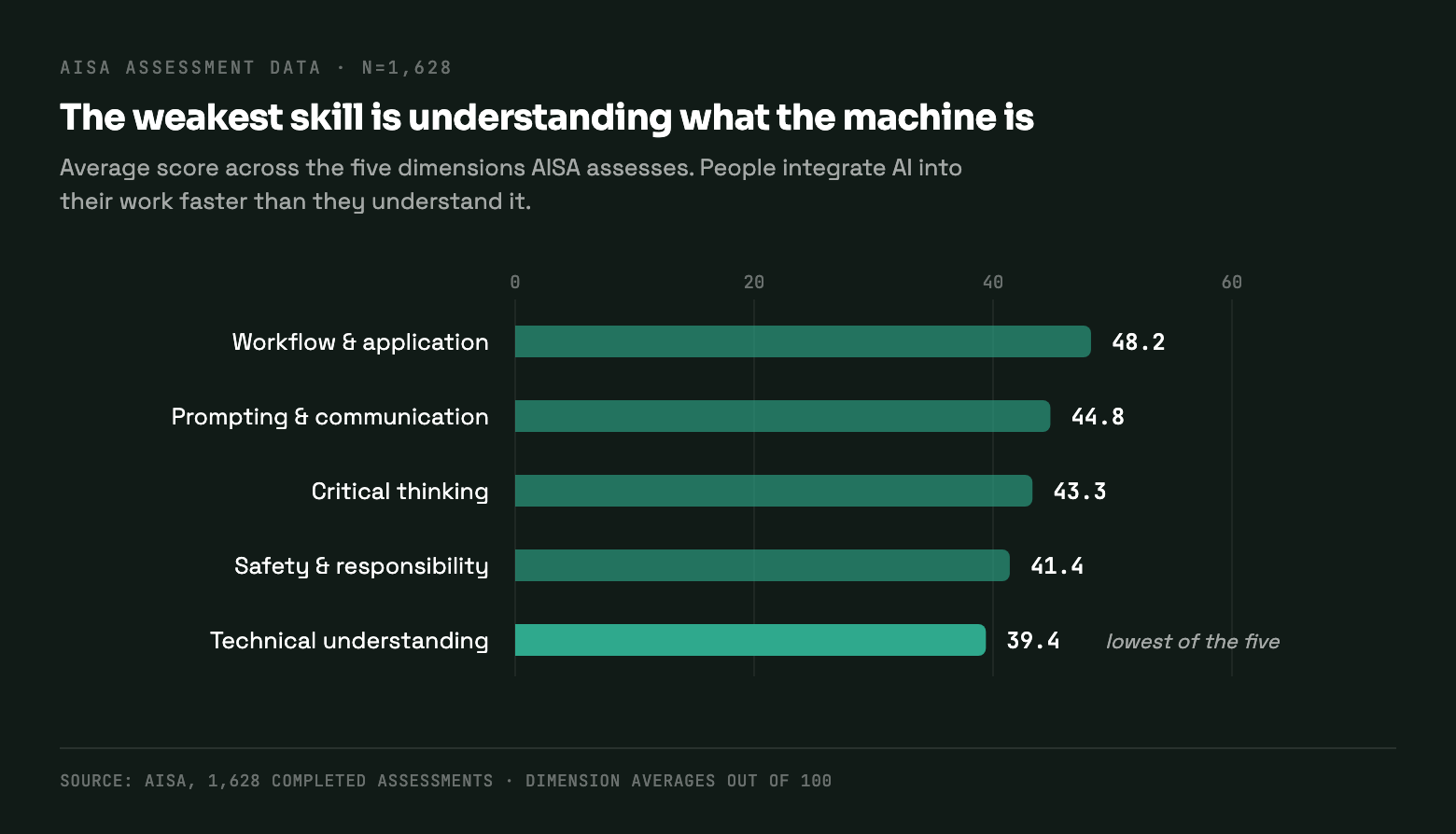
The weakest dimension is understanding what the machine is
The weakest area is understanding what the machine actually is. That is not a coincidence. It is what the replacement narrative produces. If the model is a person-substitute, there is nothing underneath to understand. It just does things, the way the robot maid just does things. Nobody in 1962 asked how Rosie's manipulator arms were calibrated.
Sixty points separate the common case from the effective one
The profile distribution tells the same story from another angle. The most common result in our data is the Dabbler, at 30% of all assessments, averaging 26.5. At the other end, the Architect profile accounts for 4.4% and averages 87.7. Roughly sixty points separate the most common way of working with AI from the most effective one, using identical tools.
| Profile | Share of assessments | Average score |
|---|---|---|
| Dabbler | 30.0% | 26.5 |
| Enthusiast | 21.5% | 52.2 |
| Builder | 15.7% | 71.4 |
| Tactician | 7.7% | 59.6 |
| Copy-Paster | 7.2% | 30.1 |
| Sceptic | 5.8% | 41.9 |
| Architect | 4.4% | 87.7 |
| Conductor | 4.1% | 71.0 |
| Bystander | 2.8% | 10.8 |
The tenth profile, the Oracle, is missing from that table because we do not publish a figure until we have at least thirty people in it, and we do not yet. That is itself a finding. Principles-level understanding of these systems remains rare enough to be hard to measure.
That spread is the actual story of AI at work right now. Not people against machines. People against other people with better technique. If you want the organisational version of that argument, it is laid out in our AI skills gap analysis, and the scoring method itself is documented in the AISA rubric.
What I Think We Should Do Instead
If AI is a tool whose output depends on the operator, three things follow, and none of them are exciting, which is rather the point. Stop debating replacement, start measuring the people holding the tools, and treat verification as a habit you train rather than a virtue you either have or lack.
First, retire the replacement debate inside your organisation. It is the wrong axis. It produces passivity in both directions: people who think the machines are coming for them disengage, and people who think the machines will handle it stop building capability. Neither behaviour helps you in a market where 39% of core skills are turning over.
Second, measure the operator, not only the tool. Every company I speak to has an opinion about which model to buy and no measurement at all of how well the people holding it can operate. That asymmetry is strange when you say it out loud. We evaluate the instrument obsessively and the musician not at all.
Third, treat verification as a trained skill rather than a personality trait. The 8.7% figure is not a moral failing, it is an untrained habit, and habits respond to practice and feedback in a way that dispositions do not.
The honest version of the future is considerably less thrilling than The Jetsons. There is no robot maid in it. There is a large, slow, uneven redistribution of advantage towards the people who learn to operate these tools properly, happening right now, mostly invisibly, while everyone argues about a cartoon.
If you would like to see where you actually stand rather than where you assume you do, our AI fluency assessment is a twenty-minute conversation and it will give you a number, a profile, and a fairly blunt account of your weakest dimension. On average, people come out about eighteen points below their own guess. It is a more useful eighteen points than any argument about robots.
Related reading: Will AI Replace My Job? Skills That Matter — the personal version of the churn question. Related reading: AISA vs Anthropic's AI Fluency Study Compared — where two independent datasets agree on what fluency is. Related reading: AI Skills Gap Analysis: Real Data — what the distribution looks like inside teams.
Frequently Asked Questions
Is AI overhyped?
The technology is not overhyped, but the story attached to it is. Capability gains are real and measurable. What is inflated is the specific narrative of wholesale human replacement, which persists because it is exciting to anticipate rather than because evidence supports it. The measurable effect so far is a widening gap between skilled and unskilled operators of the same tools.
Will AI replace human workers?
Current evidence points to churn rather than replacement. The World Economic Forum projects 92 million jobs displaced and 170 million created by 2030, with 39% of core skills changing inside five years. The practical risk to an individual is not that their role disappears, but that the skills it requires change faster than they do.
What is AI slop and how do you avoid it?
AI slop is low-quality output produced when capable models are used without verification. Anthropic found that while 85.7% of extended conversations involve iteration, only 8.7% include checking facts that matter. Avoiding it is a matter of habit rather than tooling: verify claims before refining them, and inspect the approach before executing on it.
How do you measure AI fluency rather than AI hype?
You measure behaviour, not opinion or tool familiarity. AISA assesses eleven criteria across five dimensions in a live conversation, scoring what someone demonstrates rather than what they describe. Self-reported confidence is a poor proxy: across 718 assessments, people predicted 62.1 and measured 43.9.

Ozan Dagdeviren
Founder of AISA — the AI skills assessment platform used by professionals worldwide to measure, certify, and develop their AI fluency. More about AISA
Curious about your AI Fluency?
AISA helps you measure, prove and improve your AI skills — free report in a 20–40 minute chat.