AI Upskilling and Measurement in 2027 [Strategy]
How HR, L&D and AI transformation leaders should approach AI upskilling and measurement in 2027, and where AISA is heading. A founder's view.
Nobody buys a dashboard. When an organisation invests in AI upskilling, it's buying a team that got better at AI, and the proof that it happened.
That idea is shaping how I think about AISA in 2027. I think it should also shape how HR, L&D and AI transformation teams think about AI measurement and upskilling next year. So this piece is both: my view of where the field is going, and where I'm taking AISA.
Think of it as a page from a founder's diary rather than a roadmap. It's where my head is at the end of 2026. Some of it will move as we learn, and that's exactly why I'm writing it down.
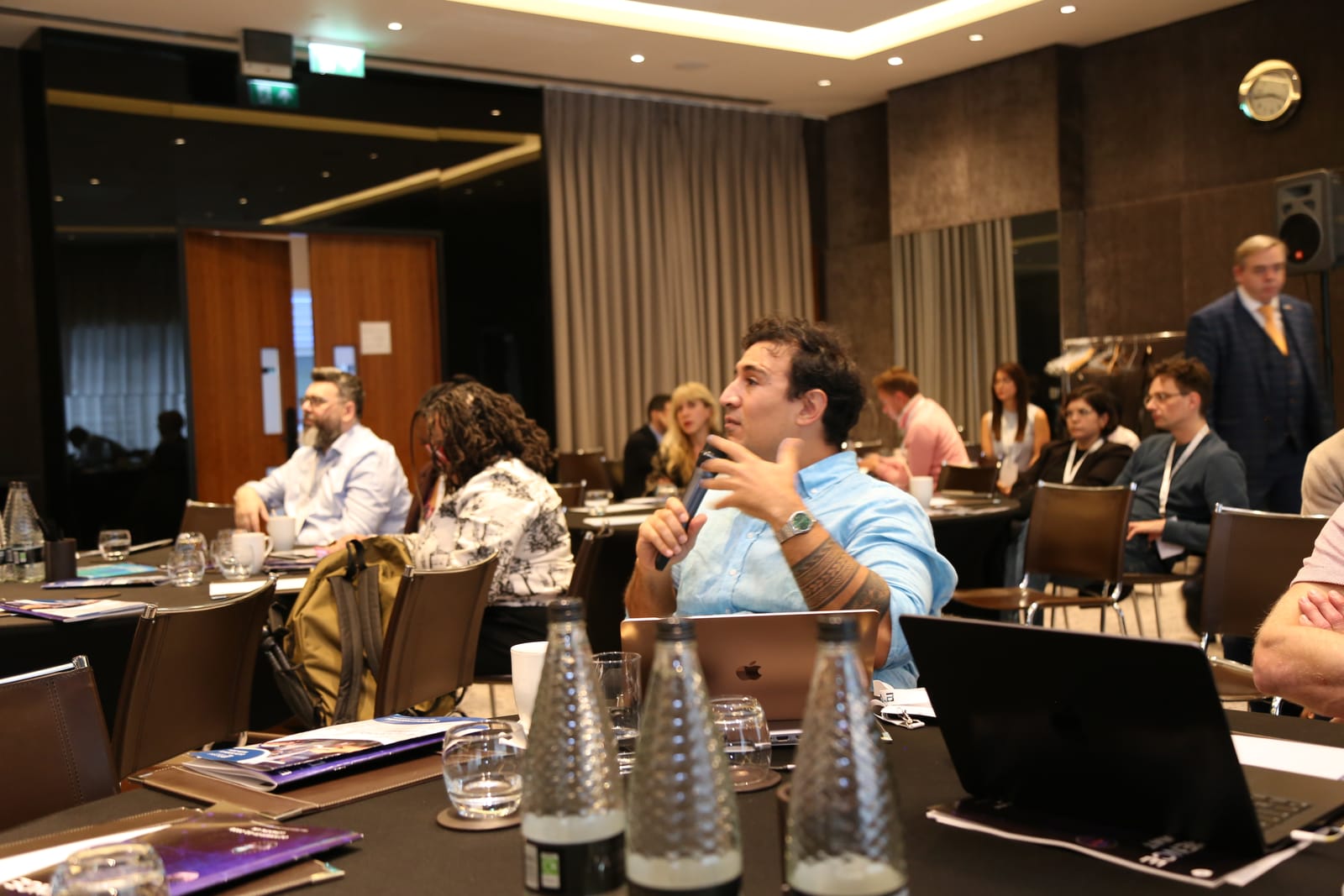
Speaking at the Data Science and AI Summit, Radisson Blu Canary Wharf, London, 1 October 2026.
How should HR and L&D leaders approach AI upskilling and measurement in 2027?
Treat AI upskilling and its measurement as one cycle, not two purchases. Measure people continuously, not once. Aim training at the gaps you measured. Treat low enthusiasm and low skill as different problems. Use your own AI champions. Then prove the result, inside the organisation and against others. These are the seven shifts I'd build 2027 around:
- Measure continuously. A one-off assessment is a snapshot. A full assessment every quarter, with short check-ins in between, gives you a trend.
- Use more than one source of evidence. A conversation shows how people think with AI. The AI tools they use every day show how they work with it.
- Build a programme, not a product. Coaching, personal learning maps, human coaching and internal training work best as parts of one AI fluency upskilling programme.
- Separate skill from enthusiasm. People with low skill need training. People with low enthusiasm need awareness and encouragement first.
- Turn your best AI people into trainers. Measurement tells you who they are.
- Keep Measure, Improve and Prove in one cycle. Each one needs the other two.
- Prove it twice. Inside, to the board and the stakeholders who funded it. Outside, against benchmarks for your industry and your roles.
The rest of this piece explains why, and how AISA fits into each one.
What did AISA build in 2026?
In 2026 AISA passed 3,000+ assessments of how people actually work with AI, refined over about 50 iterations. We published the AISA AI Fluency Index, made the certificate free for everyone, put the AI Coach on WhatsApp and started a hands-on AI community in London. Large organisations now use AISA to see where their people really stand.
A score that holds up
I've worked as an assessor and in HR long enough to be fussy about this. A score is only useful if it holds up. Ours does:
- 98% of people who retake AISA land in the same or an adjacent tier.
- 93% of Anthropic's AI fluency markers are covered, along with all 25 US Department of Labor AI literacy sub-competencies.
- 89.5% of people who start it, finish it.
The moment that mattered most to me came in September. Wingie Enuygun put its product team through AISA, eleven people including their director. He then set every result against his own read of each person, and found it a fair reflection of the team, his own score included.
A director who knows his people, agreeing with the measurement of them. That's the test I care about most.
What the data told us
We turned what we learnt into the AISA AI Fluency Index. In the August edition, the average professional scored 48 out of 100 for AI fluency.
People also think they're better than they are. On average they predict 64 and score 45, a 19-point gap. Hold on to that number; it matters for everything below.
Free for every person, and a community around it
In September we made the certificate free for everyone. Every person who takes AISA leaves with a full report and a certificate they can add to LinkedIn, at no cost. I'm proud of that one.
Around the assessment, we built the places people learn and meet:
- The AI Coach, which turns a person's own report into lessons and challenges on WhatsApp.
- Weekly winners on the leaderboard since October, each with a verified award page for LinkedIn.
- The AI Floor, our hands-on AI community in London.
- AISApedia, with 147 AI concepts explained plainly, the free guides of the AI Fluency Academy on our resources hub, and the weekly Latest AI News.
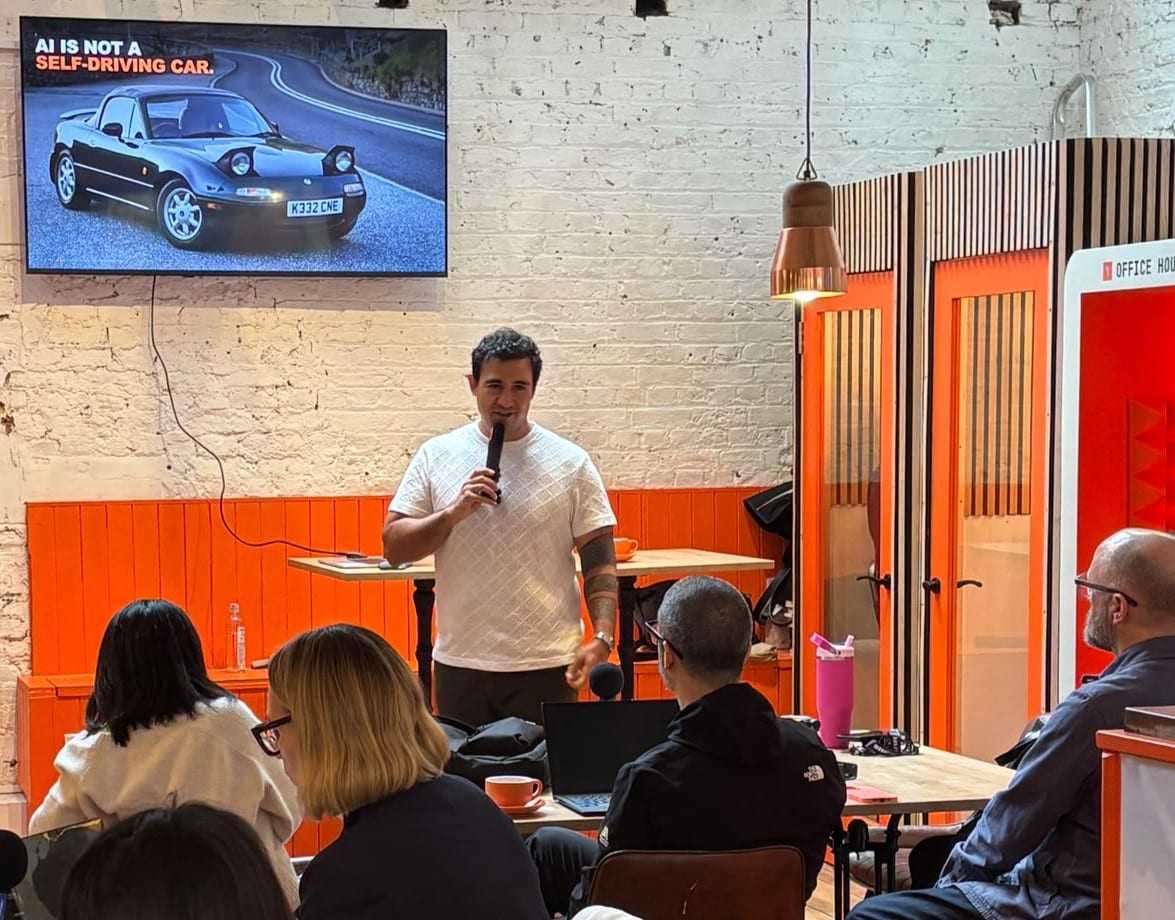
The first edition of The AI Floor, "The AI Fluency Map: How Good Are You At AI?", at Corgi Cafe, London, 24 September 2026.
To everyone who took AISA this year, and to every organisation that sent its people, Wingie Enuygun among them: thank you.
What did 2026 teach us about AI upskilling?
2026 taught me that organisations don't buy the parts of AI upskilling. They buy the outcome. A dashboard, a learning roadmap or a before-and-after report only earns its place if people end up using AI better in their real work, and the organisation can show it.
Large organisations want the whole cycle
The strongest interest we see comes from large enterprises: a global energy company, a multinational beverage group, a global analytics firm, a financial holding and its bank. They want to assess AI fluency across whole teams and functions, aim their AI training at the real gaps, design the programmes that close them, and then prove the result to the rest of the organisation.
That's one cycle, not a shopping list. It changed how I think about everything we offer.
The training gets bought. The result doesn't always follow.
Look at what employees say about the AI training they already get. 85% feel it doesn't help them understand how to use AI effectively in their role, according to Docebo's AI Readiness Gap research.
I read that as an aim problem more than a content problem. The training lands on people without anyone knowing where each of them stands.
Asking people doesn't tell you
You can't close that gap with a survey. Remember the 19 points: people overestimate their own AI fluency.
Ask a team whether the training worked and you'll hear what they believe, not what they can do.
How will AI measurement change in 2027?
In 2027 I want AI measurement to be continuous. A full AISA assessment every quarter, and a five-minute check-in every month in between, so every person and every organisation sees their AI fluency over time instead of a single snapshot. That's what I mean by continuous AI skills assessment.
A full assessment every quarter
The full assessment stays what it is: a conversation in which people show how they work with AI, scored against a published rubric, calibrated and integrity-verified. Each quarter it gives everyone a fresh, full reading.
A five-minute check-in every month
Between full assessments, Aisa checks in for five minutes a month. What have you learnt about AI since we last spoke? What have you tried, and what happened when you tested it?
Those answers keep each person's score current. Over a year, a person sees their own AI fluency move month by month, and the organisation sees the same picture for every team and function. For us, it will be one of the richest records of how AI skill actually grows.
More than one source of evidence
Conversation is how AISA works, and it shows how someone thinks with AI in a way a quiz never will. The next source I'm looking at is the AI assistant a person already uses every day. Through agent-to-agent connections, AISA could learn from that assistant and use what it learns to build a fuller AI fluency profile.
This one gets built carefully. People's privacy and their organisation's security come first, and it goes live only once it's robust.

Curious about your AI Fluency?
AISA helps you measure, prove and improve your AI skills — free report in a 20–40 minute chat.
What should an AI fluency upskilling programme include?
An AI fluency upskilling programme should start from each person's measured results and bring several parts together: AI coaching, a personal AI Fluency Map, human coaching where it helps, and the organisation's own trainers. It should also treat low enthusiasm differently from low skill. That's how I see Improve taking shape at AISA.
A programme, not a product
I'm moving AISA's Improve pillar away from single products and towards one AI fluency upskilling programme. The AI Coach is one part of it. The AI Fluency Map is another. Human coaching can be a third, and there's room for more.
Each person's programme starts from their assessment results and their AI DNA: their score, their five dimension scores, their AI persona and their personal growth plan. How they brief AI. Whether they check what comes back, or accept it as-is (what AISApedia calls cognitive surrender). How far AI is built into their work, and how safely.
No two are the same, so no two programmes should be. And every quarter, the full assessment shows how far each person has moved.
Your best AI people become your trainers
Most organisations already have people who are very good with AI. The hard part is knowing who they are.
Measurement finds them. Once you know who your AI champions are, they can train, mentor and run sessions for their colleagues, inside a system the organisation designs and AISA supports.
Sceptics need encouragement before training
This is the part I feel most strongly about. Someone with low motivation and low enthusiasm for AI doesn't need another course. They need awareness, encouragement and some excitement about what AI can do for them.
AISA's AI Enthusiasm Score shows who these people are. They get the right kind of help first, and the training budget goes to the people ready to use it.
Built into the organisation's own system
Put together, Improve means helping an organisation design its own system for getting better at AI: who trains whom, who needs encouragement first, where the budget goes. Then AISA supplements it with what we provide, wherever it helps.
It matters because 57% of employees don't feel their AI training is related to their specific role. A system built around measured people fixes the aim. It works with the training an organisation already runs, by telling it where to point.
Why should Measure, Improve and Prove come as one offer?
Because they're one lifecycle. Measure tells an organisation what to train and where it stands against others. Improve closes the gaps that measurement found. Prove shows how far AI fluency has moved. Each one needs the other two, so in 2027 I want every organisation working with AISA to get all three, together, by default.
From a basket of add-ons to one lifecycle
Our first enterprise offer was built like a basket: a core dashboard, plus add-ons that organisations picked online to build their own bundle. It suited smaller companies and tech teams that knew exactly which pieces they wanted.
Large enterprises want the result. So the core of AISA's offer becomes Measure, Improve and Prove, as one cycle:
| Pillar | The question it answers | What the organisation gets |
|---|---|---|
| Measure | Where do our people stand with AI? | Continuous AI skills assessment: every person, team and function on the same 0 to 100 scale, with a benchmark |
| Improve | Where should our budget, training and time go? | An AI fluency upskilling programme aimed at the measured gaps, built around your own trainers |
| Prove | Did our AI investment pay off? | AI fluency tracking over time, AI ROI tracking, and benchmarks against others |
Prove: AI fluency tracking and AI ROI tracking
72% of enterprise leaders now formally measure their return on AI (Wharton and GBK Collective, 2025). Prove gives them the human side of that number. That's what I mean by AI ROI tracking: the money on one side, the skill on the other.
Inside the organisation, leaders and AI teams get AI fluency tracking team by team, and can show that the investment paid off. Logins show who opened the tool. A re-assessment shows who uses it well. (We wrote up the method in AI Training ROI: Measure What Matters.)
Outside the organisation, Prove shows where it stands on AI fluency against others: on the same scale as the AISA AI Fluency Index, next to the industry average and an AI-fluent organisation benchmark.
Add-ons that stay add-ons
Some things work better as add-ons, because not every organisation needs them: AISA for hiring, and AI literacy for the EU AI Act.
As our data grows past 3,000+ assessments, new add-ons become possible. Industry benchmarks and role benchmarks are the two I'm most excited about: how your people compare with others in your industry, and with others in the same job.
Why does AI fluency tracking tie it all together?
Because everything sits on one 0 to 100 scale. A person's monthly check-in, their quarterly assessment and their organisation's benchmark are the same measure. So a person's progress and the organisation's add up: ten people who each moved is a team that moved.
AI Return = Tech X Human
I've been saying this for a while: AI Return = Tech X Human. Organisations have bought the Tech. The Human is the multiplier, and it's the half that decides what the Tech is worth.
In 2027, growing that multiplier is what I want AISA to deliver, with the evidence to show it. That's a result an organisation can take to its board, and it's how I want to talk about AISA's value from now on.
What's my one question for 2027?
Ask one question of any AI upskilling you fund: at the end of it, how will you know who got better? If the answer is a completion rate, a login count or a satisfaction score, you're buying the parts. Ask for the result instead.
AI fluency is the new currency. In 2027, organisations will want to know how much of it they hold, and whether it's growing.
So here's my dare to every HR, L&D and AI transformation leader reading this. Before you sign off the 2027 AI training budget, ask that question out loud. Then let us show you where your people stand today with a team AI assessment, and keep measuring from there.
Ozan Dagdeviren, Founder & CEO - AISA
Related reading: AI Training for Employees: Measure First, the measure, target, train and re-measure cycle. Related reading: AI Training ROI: Measure What Matters, before and after assessments that prove value to leadership. Related reading: AI Skills Assessment Accuracy: the Wingie Case Study, a product director checks AISA against his own read of his team.
Frequently Asked Questions
How should HR and L&D teams measure AI upskilling?
Measure before, during and after, on the same scale. Set a baseline for every person, team and function, aim the training at the gaps it shows, then re-assess to see how far AI fluency has moved. Don't rely on self-ratings for this: in AISA's data, professionals overestimate their AI fluency by 19 points.
What is continuous AI skills assessment?
Continuous AI skills assessment means measuring people's AI skills more than once: a baseline, then again at regular intervals and after training, on the same scale each time. It turns a one-off test into AI fluency tracking, so an organisation sees the trend, not a single snapshot. With AISA, 98% of people who retake land in the same or an adjacent tier, so a real move stands out.
What should an AI fluency upskilling programme include?
It should start from each person's measured results, not a standard course. A strong programme combines AI coaching, a personal learning map, human coaching where it helps, and the organisation's own AI champions as trainers. People with low enthusiasm for AI need awareness and encouragement first, before skills training.
How do you track AI fluency and AI ROI?
Track the human side next to the financial side. AI fluency tracking means re-assessing people on the same scale at regular intervals and after training, and comparing teams over time. AI ROI tracking puts that skill measure next to the money: 72% of enterprise leaders now formally measure their return on AI, and logins alone only show who opened the tool.

Ozan Dagdeviren
Founder of AISA — the AI skills assessment platform used by professionals worldwide to measure, certify, and develop their AI fluency. More about AISA
Curious about your AI Fluency?
AISA helps you measure, prove and improve your AI skills — free report in a 20–40 minute chat.