AI Skill Gap Analysis for Teams [2026]
An AI skill gap analysis maps exactly where your team falls short — by dimension, role, and person. Here is how to run one that drives targeted investment.
An AI skill gap analysis identifies the specific difference between the AI skills your workforce currently has and the AI skills your organisation needs. In 2026, with AI embedded in nearly every professional workflow, this isn't an academic exercise — it's the difference between targeted training investment and wasted budget.
Most organisations skip this step. They see competitors adopting AI, feel the urgency, and immediately buy training. The result: generic courses that bore the advanced users, overwhelm the beginners, and address nobody's actual gaps. An AI skill gap analysis prevents this by measuring first.
What an AI Skill Gap Analysis Reveals
A proper AI skill gap analysis goes far beyond "our team scored 62 out of 100." It answers five specific questions:
Which AI skill dimensions are weakest? AI proficiency isn't one skill — it's at least five. Someone might be an excellent prompt engineer but terrible at evaluating AI output. A team might have strong technical understanding but no safety awareness. Dimension-level gaps drive fundamentally different training investments.
Which roles have which gaps? Developers and marketers rarely have the same AI skill profile. A useful gap analysis breaks down by role, revealing that engineering needs safety training while marketing needs critical evaluation workshops.
How wide is the distribution? A team where everyone scores similarly needs uniform training. A bimodal team — some experts, some beginners — needs peer learning programmes or differentiated tracks.
Where are the critical blind spots? Some gaps are more dangerous than others. A team that's productive with AI but doesn't evaluate output (low critical thinking) is generating confident-looking work with unknown error rates.
What's the baseline for measuring training ROI? Without a pre-training measurement, you can never answer "did our training investment work?"
How AISA Runs an AI Skill Gap Analysis
AISA was purpose-built for workforce AI skill measurement. Here's the pipeline from assessment to actionable gap data.
Step 1: Individual Conversational Assessment
Each team member has a 20–40 minute conversation with Aisa, an AI interviewer who adapts questions based on their responses. No quizzes. No multiple choice. The conversation explores how they actually use AI in their real work.
Behind the scenes, a dual-track AI system evaluates every response:
- Track A talks to the person — asking follow-up questions, running interactive exercises, probing depth
- Track B silently evaluates each response against 11 criteria across five dimensions
After the conversation, a calibration pass reviews the full transcript holistically.
Step 2: Five-Dimension Scoring
Each person receives scores across AISA's five AI skill dimensions:
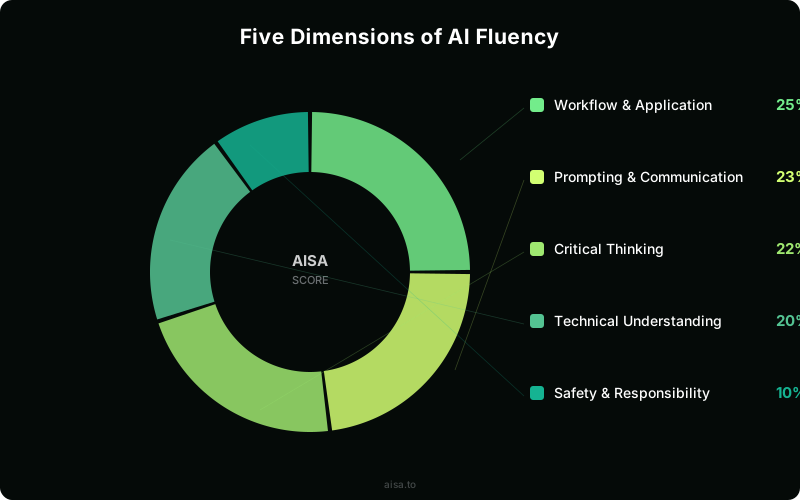
| Dimension | What it measures | Common gaps |
|---|---|---|
| Prompting & Communication | Prompt structure, iteration, context management | Accepting first outputs; no iteration |
| Critical Thinking | Output evaluation, limitation awareness | Trusting AI output without verification |
| Technical Understanding | AI fundamentals, tool landscape knowledge | Black-box usage; one tool for everything |
| Workflow & Application | Integration depth, task decomposition, domain use | Experimental use only; not embedded |
| Safety & Responsibility | Risk awareness, data boundaries, downstream thinking | No consideration of data exposure |
Within each dimension, individual criteria are scored separately — granular enough to distinguish someone who's strong at prompt design but weak at iterative dialogue.
Step 3: Individual Reports
Each person receives a detailed private report:
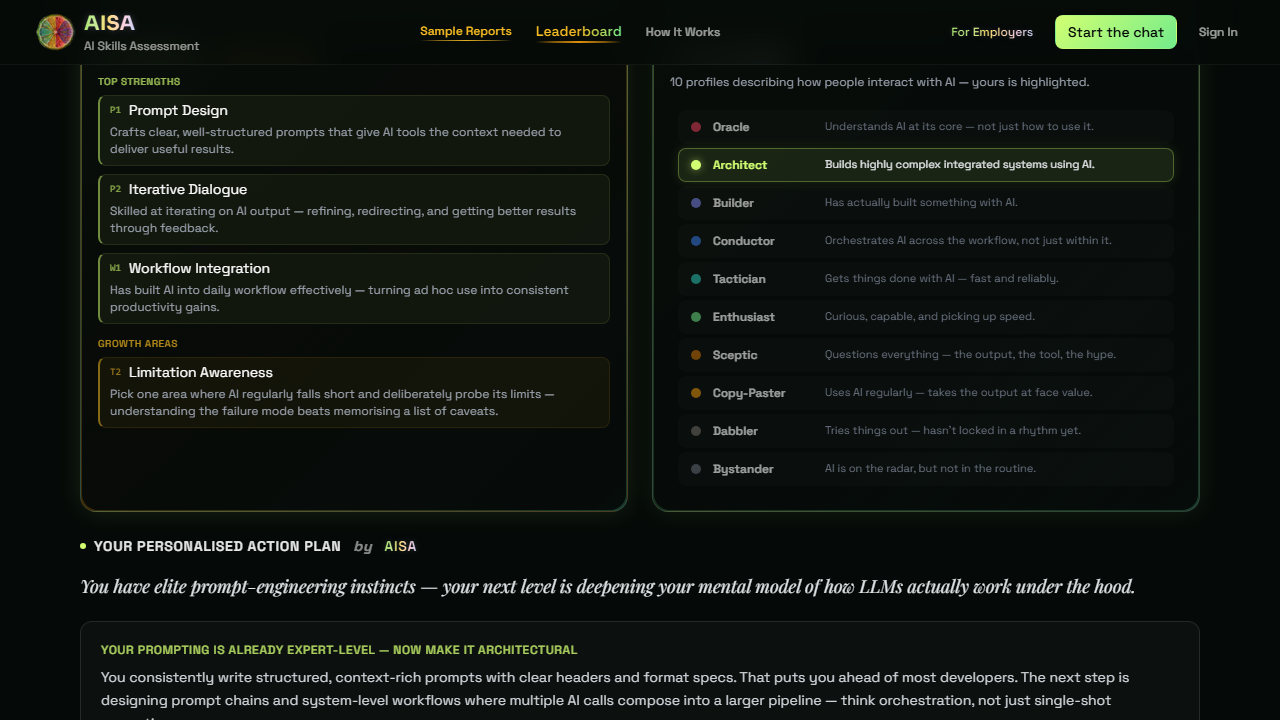
- Composite score (0–100) with tier classification (Emerging, Developing, Proficient, Advanced, Expert)
- Five dimension scores revealing the profile shape
- 11 criterion scores for maximum granularity
- AI Persona — one of 10 persona types that describes how they use AI
- Personalised growth recommendations calibrated to their specific gaps
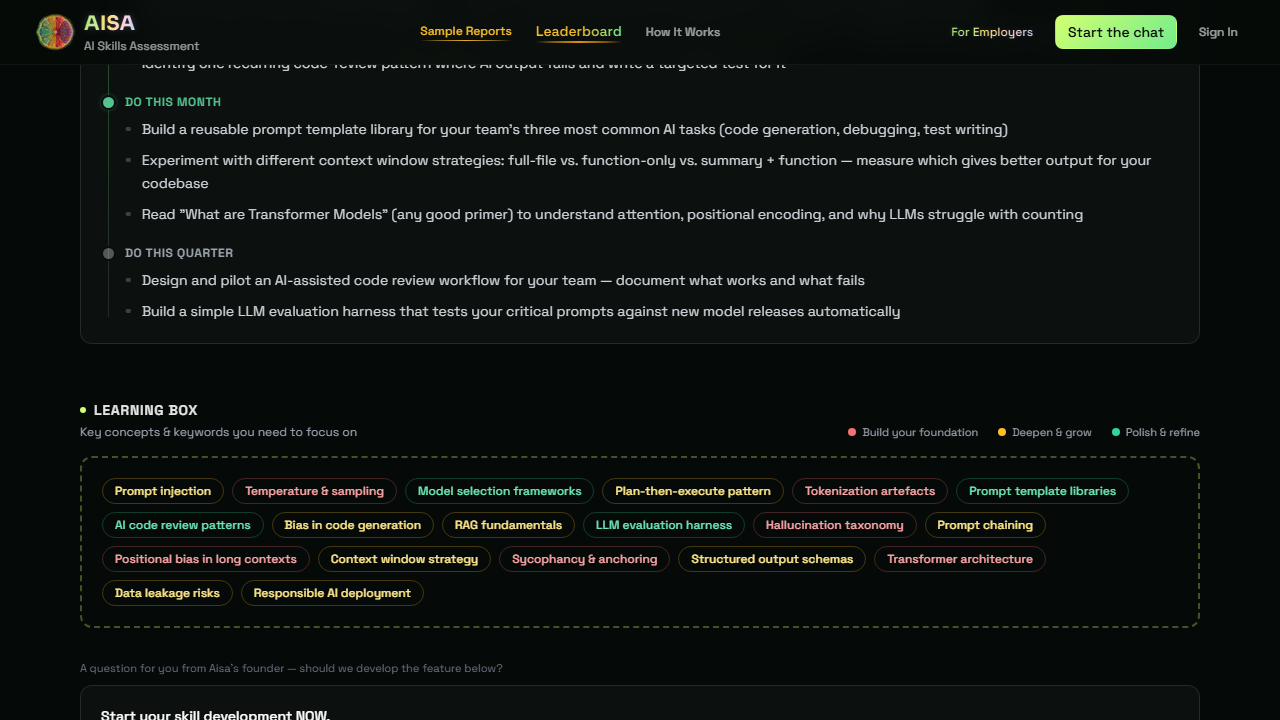
Step 4: Team Dashboard and Gap Identification
Individual assessments aggregate into the team intelligence dashboard:
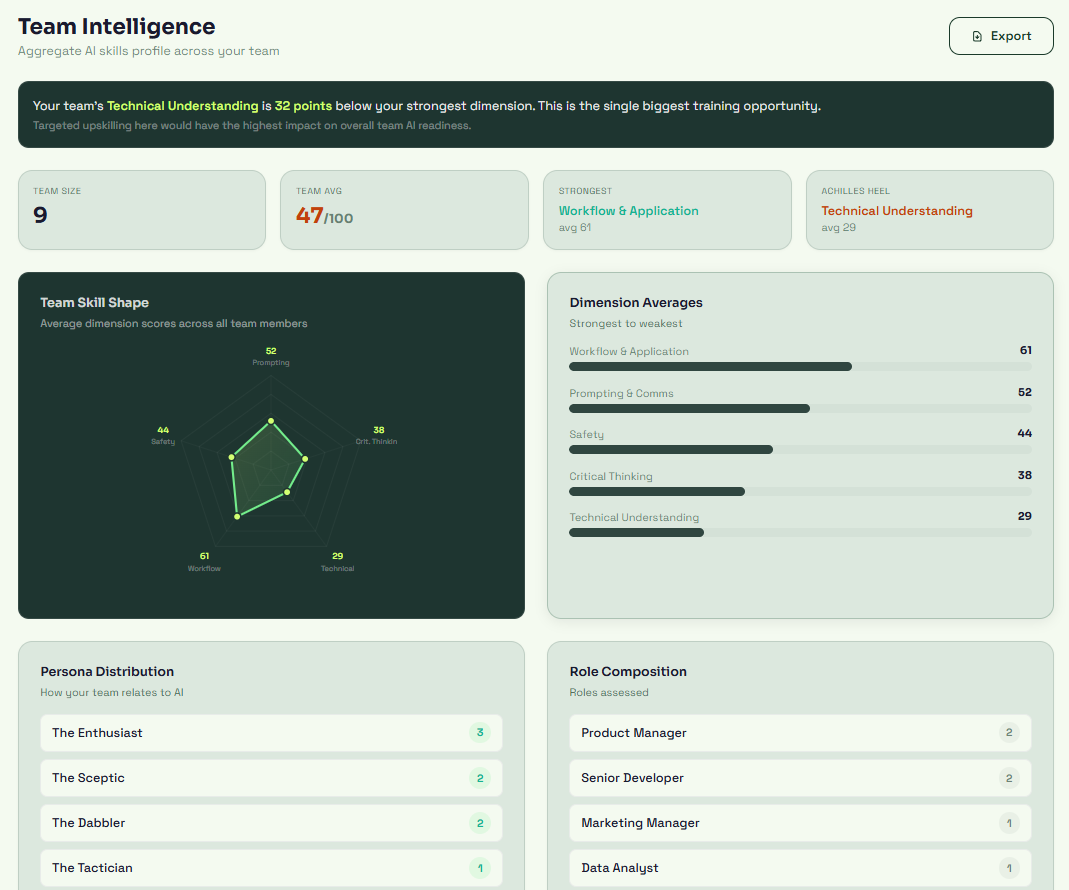
The dashboard surfaces the gaps that matter for investment decisions:
Team-wide dimension gaps — If 70% of your team scores below 40 on Critical Thinking, that's a training priority regardless of role.
Role-specific patterns — Developers averaging 75 on Technical Understanding but 30 on Safety tells you exactly what training to buy for engineering.
Skill distribution shape — A tight cluster means uniform training works. A wide spread means you need differentiated tracks.
Individual outliers — People significantly above or below team average may need specialised development or could serve as internal champions.

Curious about your AI Fluency?
AISA helps you measure, prove and improve your AI skills — free report in a 20-minute chat.
Why Granularity Changes the Training Equation
The difference between a gap analysis and a simple score is the difference between a targeted investment and a guess.
Without gap analysis: You spend $50,000 on an enterprise AI training programme. Everyone takes the same course. Developers are bored — they already know the technical content. Marketers are lost — the examples are all code-based. Executives skip it — the content is too tactical. Completion rate: 40%. Measurable impact: unknown.
With gap analysis from AISA: You discover that marketing's gap is Critical Thinking (they produce with AI but don't verify), engineering's gap is Safety (they build but don't consider implications), and leadership's gap is Workflow (they understand AI strategically but haven't integrated it personally). You invest in three targeted programmes. Every dollar addresses a measured gap. You re-assess in 90 days and measure the improvement.
Most organisations waste 40–60% of their AI training budget on content that doesn't address actual gaps. Measuring first isn't just more efficient — it typically halves the effective cost of training by doubling the impact per dollar.
Getting Started with an AI Skill Gap Analysis
An AI skill gap analysis with AISA works at any scale:
- Pilot (5–10 people): Run assessments, review the team dashboard, validate the output quality
- Department (50–200 people): Deploy via email invitations, aggregate by role and function, use results to shape the next training budget
- Enterprise (500+ people): Phase by department, start with teams closest to AI adoption, use early data to build the business case
Each assessment takes 20–40 minutes per person. No scheduling, no facilitator, no preparation. Organisations get 3 free credits to pilot.
The hardest part of an AI training strategy isn't finding a course. It's knowing which course to buy, for whom, and why. The gap analysis is where that clarity comes from.
Frequently Asked Questions
How long does an AI skill gap analysis take?
Each individual assessment takes 20–40 minutes. For a team of 20, you can have all assessments completed within a week (people take them on their own schedule). The team dashboard aggregates results automatically — no manual analysis required.
Can AISA measure AI skills for non-technical roles?
Yes. AISA's conversational assessment adapts to every role. A product manager gets different questions than a software developer, but both are evaluated against the same 11-criteria framework. The system measures AI fluency across the full spectrum of professional roles.
What's the difference between an AI skill gap analysis and a training needs assessment?
They're closely related. A skill gap analysis identifies where the gaps are. A training needs assessment goes further — mapping gaps to specific training interventions and building the case for investment. AISA's output serves both purposes because it provides dimension-level and role-level granularity.
How do you measure AI training ROI after the gap analysis?
Re-run AISA assessments after training. Compare pre- and post-training scores by dimension, by role, and by individual. The numeric scores make ROI calculation straightforward: "Critical Thinking scores in marketing improved from 35 to 58 after the evaluation workshop series."
Related reading: AI Training Needs Assessment — the full L&D framework for turning gap data into training ROI. AI Readiness Assessment Tools Compared — choosing the right measurement platform. Test Your AI Knowledge — for individuals wanting to assess themselves first.

Ozan Dagdeviren
Founder of AISA — the AI skills assessment platform used by professionals worldwide to measure, certify, and develop their AI fluency. More about AISA
Curious about your AI Fluency?
AISA helps you measure, prove and improve your AI skills — free report in a 20-minute chat.